Artifact of the Quarter | March 2017
Can it Stop a Bullet?: Body Armor in the Civil War
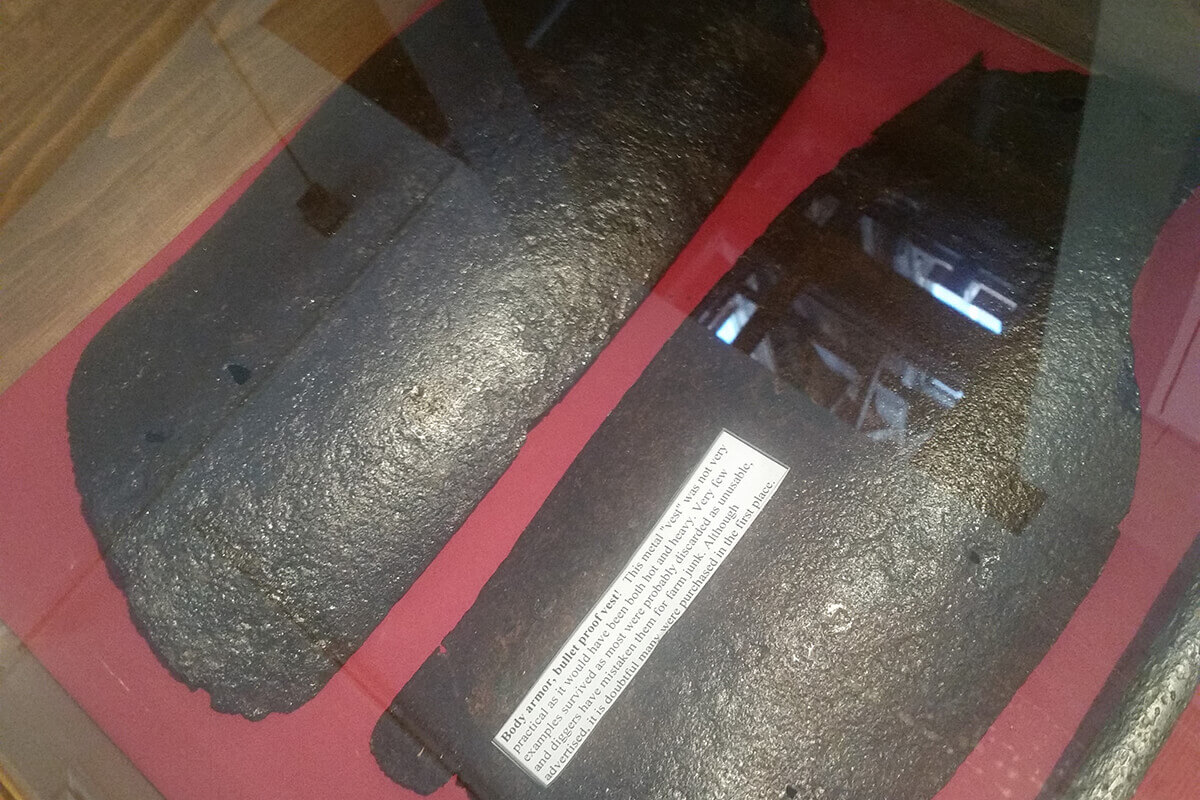
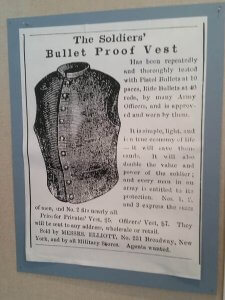
While the notion of our armed forces wearing some form of body armor to protect them from bullets is a common thought today, it was a revolutionary one during the Civil War. This early form of a “bulletproof vest” possibly provided the wearer with a sense of protection in the heat of battle. Harper’s Weekly, a New York-based newspaper which had a national reader base, advertised such items in its papers. The advertisements claim them to be “Thoroughly tested by pistols at ten paces (8 yards), and rifles at forty rods (220 yards),” and that this new technology would “save thousands.”
Unfortunately, the results did not always emulate the promise. Some soldiers decided to test the new technology themselves. Colonel Charles F. Johnson, a member of the Invalid Corps (later to be renamed the Veteran Reserve Corps), was one such soldier. He wrote home to his wife, in May 1862, that he and some of his comrades were going to test their new vests; he resumed the letter by stating “just returned with the great, mighty, powerful ‘bullet proof’ vest and the result is that a common musket put a ball clear through it at 50 yards, through yes, and carried some four or five inches of the stuff with it.” Johnson also believed that such a wound would “Kill the devil himself if it all had entered through his body.”[1] Even with mixed results and presumably low sales, this “bullet-proof” vest stands as a testament to the varying efforts at invention and innovation that occurred during the Civil War. This particular artifact is on display at the Old Courthouse Civil War Museum in Winchester, Virginia.
[1] Fred Pelka, ed. “The Civil War Letters of Charles F. Johnson, Invalid Corps.” (Boston: University of Massachusetts Press, 2004), 112-113.