Home » Blog » Artifact of the Quarter | December 2017

Artifact of the Quarter | December 2017

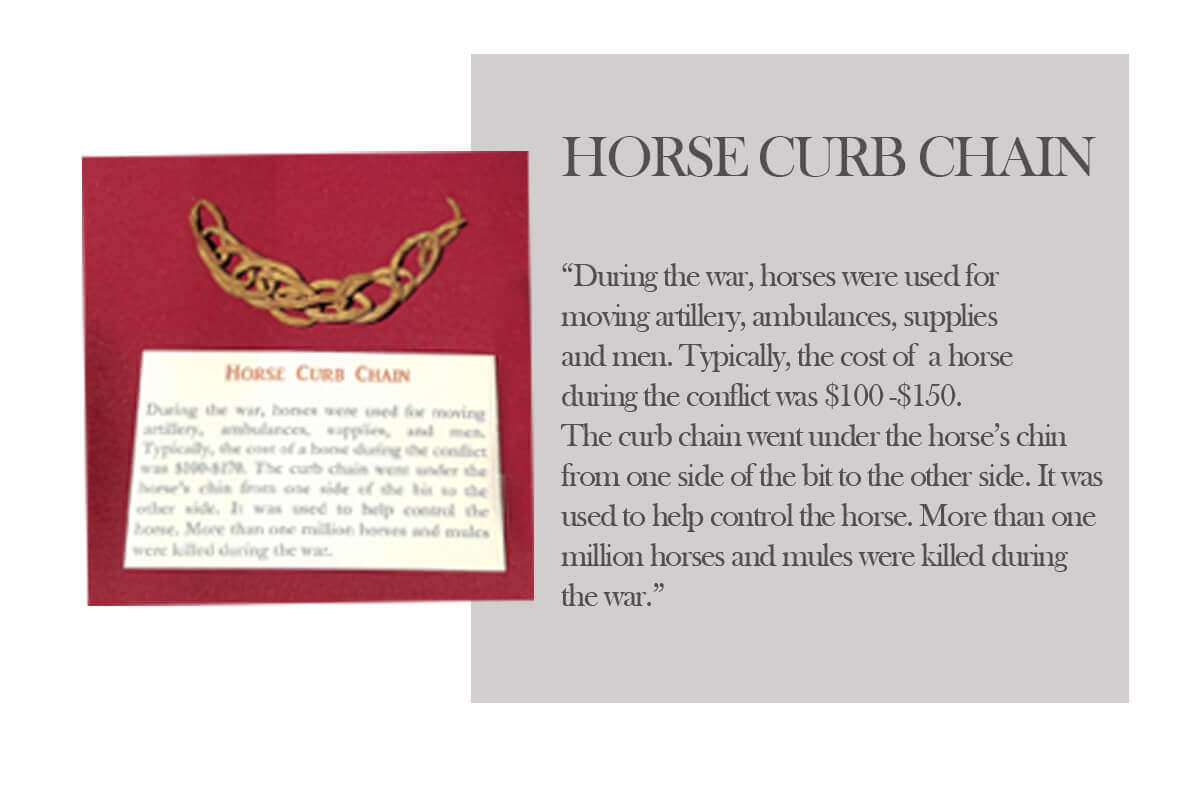
Horse’s Curb Chain at Cool Spring
Contributed by Shelby R. Shrader

One of the greatest challenges for Union or Confederate forces during the Civil War was moving massive armies and all of the supplies necessary to keep those commands properly fed and equipped. While locomotives proved useful, armies could not have functioned had it not been for horses. From moving artillery, foodstuffs, ammunition, medical supplies, etc. both armies leaned heavily on horses. 

During the Civil War the average cost of a horse was $150. Horses had to meet strict requirement for military use and had to be sturdy so that they could not only carry riders, but also haul heavy loads. Horses’ hooves also had to be in good condition to ensure they could carry their riders or cargo long distances. Additionally, horses could not be skittish, and had to be able to trot and gallop easily. Most horses that saw service during the conflict were between the ages of five and seven years old. 

Once accepted for military service, horses usually had a short training period. The curb chain, pictured above from the exhibit housed in the Lodge at the university’s Shenandoah River Campus at the Cool Spring Battlefield, was often used to aid in better controlling a soldier’s steed during battle. The curb chain went under the horse’s chin from one side of the bit, and attached to the other side of the bridle.  More than one million horses or mules were killed during the Civil War. The most common cause of death was from exhaustion. Other common causes of death included disease and being killed in combat. 

Although oftentimes overlooked, horses played a crucial role throughout the Civil War. Simply put, horses were the engines that kept armies on the move. 

Categories: , ,

Recent News

Hundreds of Little Wars: Community, Conflict, and the Real Civil War. The 12 essays in this volume offer important perspectives about how the conflict impacted communities such as Fauquier County, Virginia, and Kentucky’s Lower Green River Country.

Publication of Note | June 2026

G. David Schieffler and Matthew M. Smith, eds. “Hundreds of Little Wars: Community, Conflict, and the Real Civil War.” Baton Rouge: Louisiana State University Press, 2025.

Author Kate DiCamillo in front of a pink and green balloon arch and a slide that says "How to Make a Writer" on stage at Shenandoah University's Ohrstrom-Bryant Theatre in 2026 for the university's Children's Literature Conference's Rally for Reading.

Rally Kicks Off A Season Celebrating Reading

Shenandoah University Children’s Literature Conference Marks 40th Year By Introducing Students to Nation’s Top Children’s Authors and Illustrators

Maria Saikali '24, '26, prepares to graduate with her MBA at Shenandoah University's 2026 University Commencement in the James R. Wilkins Jr. Athletics & Events Center. She is wearing her cap and gown.

Family In More Ways Than One

Maria Saikali ’24, ’26 Graduates From Shenandoah University With Her Sister and Her Mother

Group photo at the Veteran Appreciation BBQ event.

Shenandoah University Hosts Veteran Appreciation Cookout

Event was hosted by SU's Hub for Innovators, Veterans and Entrepreneurs and the Northern Shenandoah Valley Community Veteran Engagement Board

A student presents her research poster at a conference.

Shenandoah University Biology Student Presents Research At Pittcon

Sophia Menyhart ’26 also earned a research award from the Virginia Section of the American Chemical Society

Students pose at a booth for the Shenandoah Center for Immersive Learning.

Shenandoah University Advanced Technology Students Thrive At Prestigious Conference

Three students were awarded scholarships, two presented VR projects at I/ITSEC in Orlando, Florida

Monthly Archives