Home » Blog » Artifact of the Quarter | March 2018

Artifact of the Quarter | March 2018

Phoenix Shot Tower
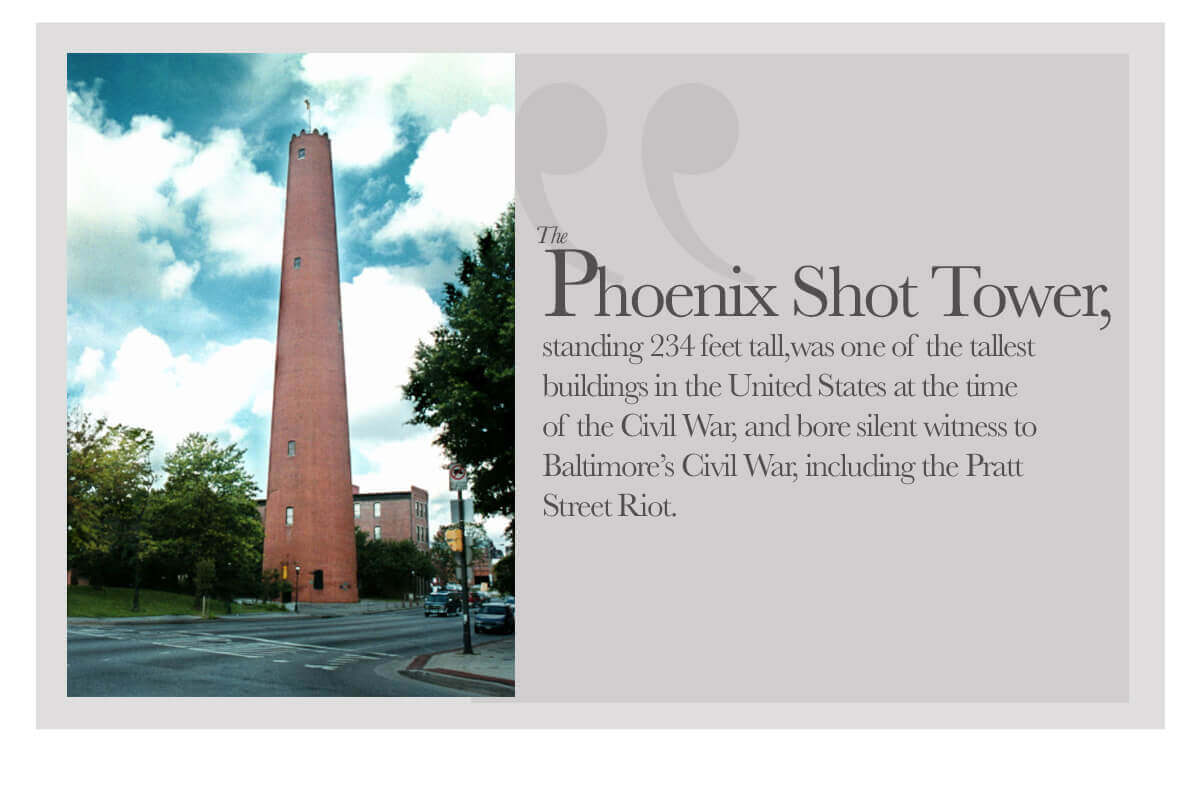
While driving on I-83 in Baltimore, Maryland, one massive, legendary eyewitness to the Civil War rises prominently into the sky and is visible from miles away—the Phoenix Shot Tower.  Standing 234 feet tall, it was one of the tallest buildings in the United States at the time of the Civil War, and bore silent witness to Baltimore’s Civil War, including the Pratt Street Riot.

Built in 1828, just north of President Street Station, the tower sits in a bustling part of the city. The shot tower produced pistol and rifle shot that supplied thousands of soldiers during the Civil War. The production process started by dropping hot, molten lead from the top of the 234-foot-tall tower. The lead started to take shape into perfect spheres as it travelled down the neck of the tower and landed in a large barrel of cold water at the tower’s base. Finally, the lead pellets were sifted through a sieve.

It is estimated that approximately 2.5 million pounds of shot were manufactured in the tower annually. The tower, however, became obsolete in 1892, when new methods of shot production were developed, forcing the once-overworked tower into irrelevance. In 1921, the tower was almost destroyed, which would have eliminated one of Baltimore’s most iconic Civil War-era structures. Fortunately, a contingent of Baltimore civilians protested its destruction, and on Oct. 11, 1924, a group of these preservationists raised $17,000 — more than $200,000 by today’s monetary standards — to save the Phoenix Shot Tower. Today the Phoenix Shot Tower is a working museum, providing visitors with a tangible connection to Baltimore’s Civil War-era history.

The Phoenix Shot Tower Museum is open Monday through Saturday from 9 a.m. to 4 p.m. 

More information about the museum can be found online at carrollmuseums.org.

Categories: , ,

Recent News

Hundreds of Little Wars: Community, Conflict, and the Real Civil War. The 12 essays in this volume offer important perspectives about how the conflict impacted communities such as Fauquier County, Virginia, and Kentucky’s Lower Green River Country.

Publication of Note | June 2026

G. David Schieffler and Matthew M. Smith, eds. “Hundreds of Little Wars: Community, Conflict, and the Real Civil War.” Baton Rouge: Louisiana State University Press, 2025.

Author Kate DiCamillo in front of a pink and green balloon arch and a slide that says "How to Make a Writer" on stage at Shenandoah University's Ohrstrom-Bryant Theatre in 2026 for the university's Children's Literature Conference's Rally for Reading.

Rally Kicks Off A Season Celebrating Reading

Shenandoah University Children’s Literature Conference Marks 40th Year By Introducing Students to Nation’s Top Children’s Authors and Illustrators

Maria Saikali '24, '26, prepares to graduate with her MBA at Shenandoah University's 2026 University Commencement in the James R. Wilkins Jr. Athletics & Events Center. She is wearing her cap and gown.

Family In More Ways Than One

Maria Saikali ’24, ’26 Graduates From Shenandoah University With Her Sister and Her Mother

Group photo at the Veteran Appreciation BBQ event.

Shenandoah University Hosts Veteran Appreciation Cookout

Event was hosted by SU's Hub for Innovators, Veterans and Entrepreneurs and the Northern Shenandoah Valley Community Veteran Engagement Board

A student presents her research poster at a conference.

Shenandoah University Biology Student Presents Research At Pittcon

Sophia Menyhart ’26 also earned a research award from the Virginia Section of the American Chemical Society

Students pose at a booth for the Shenandoah Center for Immersive Learning.

Shenandoah University Advanced Technology Students Thrive At Prestigious Conference

Three students were awarded scholarships, two presented VR projects at I/ITSEC in Orlando, Florida

Monthly Archives