A Polite Defender of Academic Integrity
Business Faculty Member Battles Corrosive Aspects of Collegiate Sport Through Role With The Drake Group
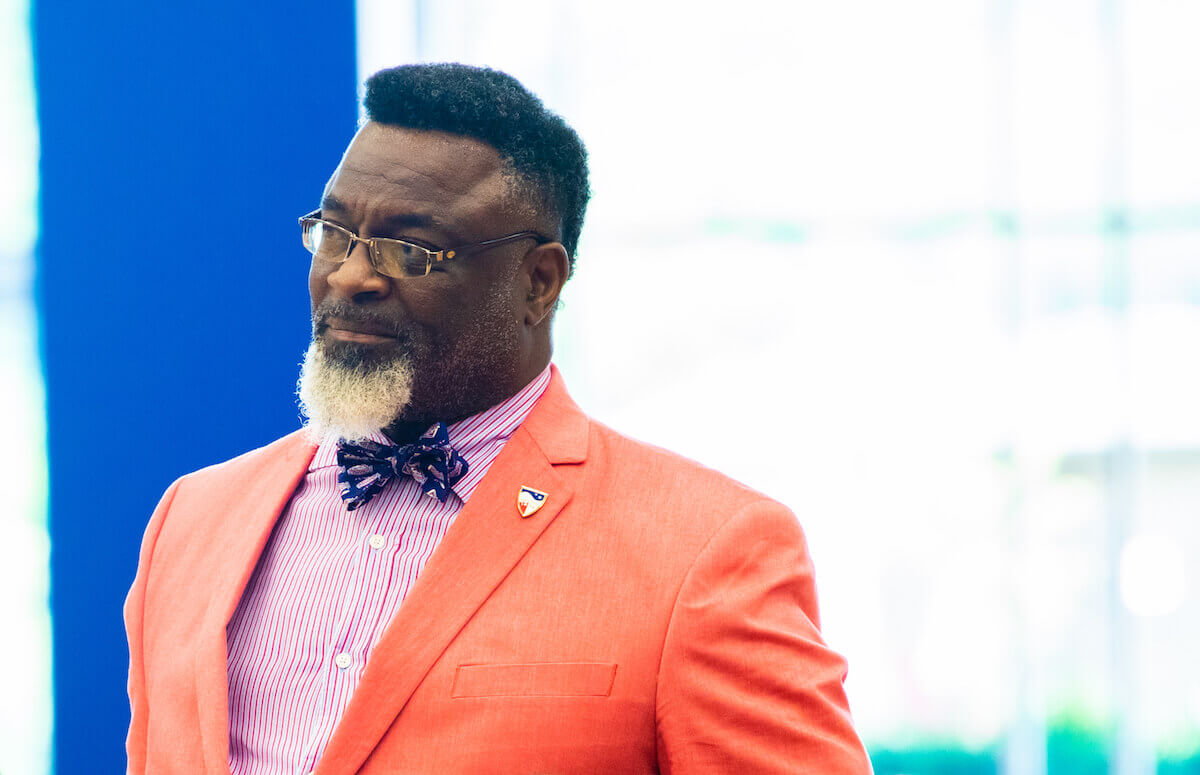
Back in 2000, Shenandoah Assistant Dean for Student Affairs at the Harry F. Byrd, Jr. School of Business Fritz Polite, Ph.D., was a Florida State University graduate student looking to get involved in a professional organization.
The former college and professional athlete’s academic mentor just happened to be part of a group of faculty from around the country who had gathered to discuss their views on the commercial aspects of college sports. So, Polite joined as a student member of The Drake Group, learning from top researchers in the field of college sport like Allen Sack, Drake Group co-founder and author of “Counterfeit Amateurs: An Athlete’s Journey Through the Sixties to the Age of Academic Capitalism.”
Defending Academic Integrity
Dr. Polite remained a member over the years, and now he serves as the president of the organization, which states that its mission “is to defend academic integrity in higher education from the corrosive aspects of commercialized college sports,” according to its website. “The Drake Group vision is to create an atmosphere on college campuses that encourages personal and intellectual growth for all students, and demands excellence and professional integrity from faculty charged with teaching.”
The Drake Group acts as a conscience for college athletics, which Polite said has become a multibillion-dollar industry. Sometimes, a public university’s head football or basketball coach is a state’s highest-paid public employee, he added.
Collegiate athletics also offers an extreme range of experience, he said, from a large, Division I university where there’s a coach with a $9 million salary and a team that plays in a 100,000-seat, $175 million stadium, to a Division III school, where a stadium seats 3,000, a coach may make a $150,000 salary, and students are focused on building careers on Wall Street, not the National Football League, unlike their Division I counterparts.
Asking Necessary Questions
Drake’s role, Polite said, is to ask, as a group of professional, competent, educated voices, “How does this fit into the academy? How does this impact the academic model? Does this really make sense? Does a student get a quality education when they’re practicing a sport for 65 hours a week?”
“The Drake Group is about principle,” Polite said. And it has been a consistent thorn in the side if the National Collegiate Athletics Association (NCAA).
Working On Behalf Of College Athletes
In early September, The Drake Group issued a statement criticizing “NCAA for the failure of its member institutions to protect college athletes from injury, abuse, and academic exploitation.”
“The NCAA was created in 1906 because of deaths in collegiate football and a threat by the President of the United States to ban college football,” Polite said in the statement. “The NCAA and many similar state and national athletic governance organizations are running away from this responsibility because of they fear legal liability for the failures of member institutions to protect athletes. The Drake Group believes this position is unconscionable.”
“The recent death of University of Maryland football player Jordan McNair reflects the NCAA’s failure to lead in preventing heat-related injuries,” Polite said in the statement. “The McNair death should not have happened. Each year the NCAA publishes its Sports Medicine Handbook, which identifies standard practices that would protect the health of college athletes, but it does NOT require its member institutions to follow those practices. Why? Because it fears that it will be held legally liable if it does not enforce such rules. Athletic governance organizations must recognize that member institutions may seek unfair advantage in pursuit of championship seasons, increased revenues, and favorable publicity. They must also understand that powerful forces on the campus level (prominent trustees, charismatic winning coaches, etc.) may pressure the institution to turn a blind eye to athlete abuse or exploitation in the quest for athletic supremacy. The Drake Group maintains that the basic function of the NCAA and other athletic governance associations must be to make and enforce rules that enable members to overcome such influences. The NCAA should establish, as a condition of membership, adherence to its published sports medicine guidelines. All national athletic governance organizations should have Codes of Conduct applicable to coaches and staff that protects athletes from coach/staff misconduct. Expecting member institutions to self-police is a dereliction of duty with regard to the basic responsibilities of a national athletic governance organization.”
Hoping To Facilitate Change
Additionally, current goals of The Drake Group include advancing “federal legislation that would compel revisions in governance necessary to eliminate or reduce the corrosive aspects of commercialized college sports.”
Until such a goal is met, The Drake Group will keep speaking out about the problems it sees, with Polite’s voice front and center.