MT Interviews with Ray Leone ’86, ’17 MT-BC
Music Therapists in Our Community Interview
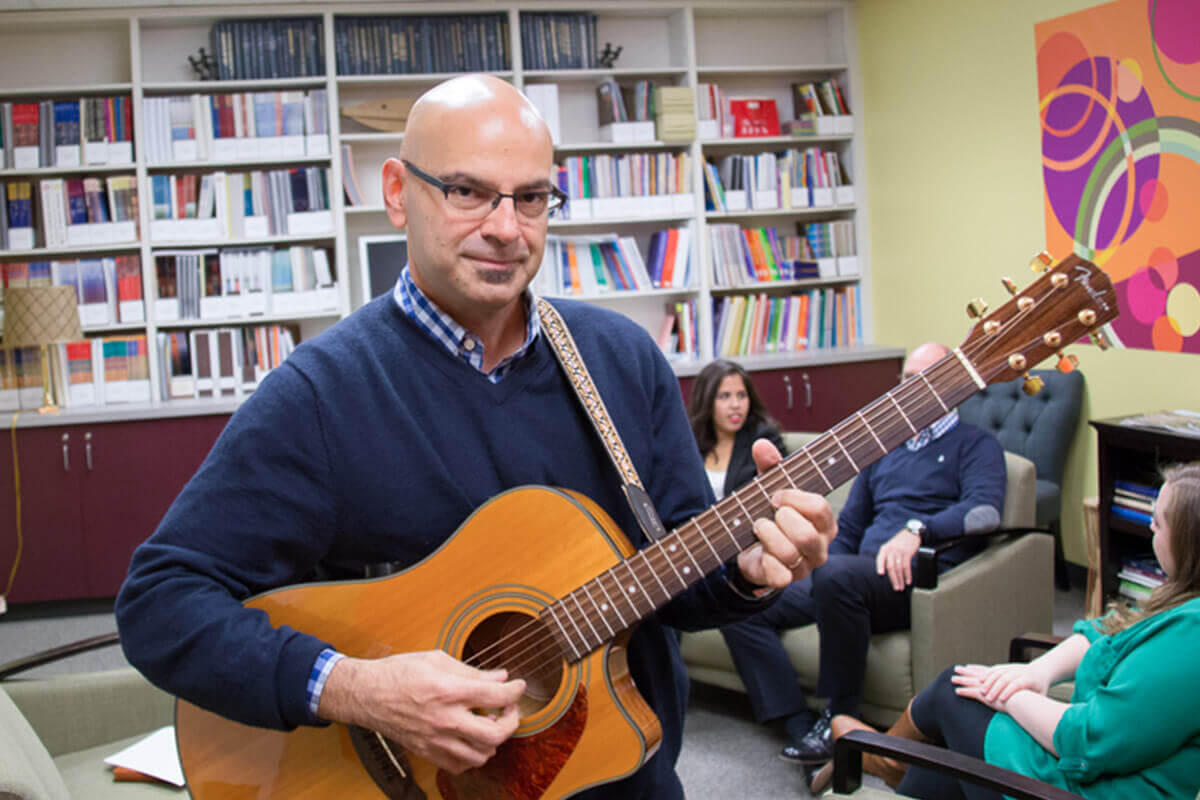
Ray Leone ’86, ’17 MT-BC
Master of Music Therapy
Bachelor of Music
Ray’s Background
My name is Ray Leone and I direct the medical music therapy program at Inova Healthcare. I actually didn’t study music therapy as my undergraduate degree. I was a music major and I worked and performed as a professional musician for many years. When I chose to go into music therapy, I completed the professional studies program at Montclair State University in New Jersey before completing my master’s degree at Shenandoah. I now work for A Place to Be and oversee all of music therapy provided at Inova hospitals. When I work clinically, I spend most of my time at Inova Loudoun hospital and work mainly with adults in the intensive care and oncology units.
When I worked as a professional musician, I started doing performances for kids with special needs and I saw how the kids responded in such a positive way to the music. So I started to do research into music and therapy, and I read an article about a gentleman who was also a children’s performer who transitioned into training and working as a music therapist. That is what really inspired me to go back to school for music therapy.
Initially, I thought I was going to work with children with special needs, but after experiencing different populations in practicum, I found the hospital setting very interesting. I did my internship at the Louis Armstrong Center for Music and Medicine at Mount Sinai Beth Israel in New York City. My supervisor, Andrew Rossetti, was an incredible guitarist and an incredible clinician with his guitar. So, once I started seeing the work he was doing in oncology using improvisational techniques to ease anxiety and stress and to promote relaxation, it really clicked for me in terms of what music therapy could do and I really felt drawn to working in this area.
What it’s Like to Work at Inova?
Working in oncology is very unique. Most of the work is focused around helping the patient work through psychological and emotional aspects of their disease. I may get a referral for a patient who has just been diagnosed for the first time and they are coming to terms with the diagnosis. Or I may see a patient who is going through treatment. Or I may see a patient at the end of their life when there is nothing that can be done medically.
Generally, I use music and songs in the emotional realm to figure out how patients are feeling and then put a plan together to manage their emotions and anxiety as they work through treatment. I also use improvisational music to help patients manage pain and anxiety. When I first start working with a patient in oncology, I give them a list of songs from many different genres and ask them to pick a song that may speak to how they feel in the moment. Music is a great facilitator of emotions, especially when a person doesn’t know how they are feeling – and the music gives them a place to start. It can be a very emotional to experience the feelings that they have been letting build up inside, but also very cathartic to release them.
On a day-to-day basis, each day is different when you work in a hospital setting. When I go into the hospitals, I don’t know who I am going to be working with. Depending on the unit I am on, I will round with the nurses and I will talk with the supervisor or the nurses working bedside and ask which patients would benefit from music therapy that day. Sometimes the referral could be immediate, meaning there is a patient who has a procedure scheduled later in the day and they are feeling anxious about it. Or they tell me about a patient who is coming back from a procedure at a specific time and may benefit from music therapy to manage pain. So I typically compile referrals in the morning and work through them for the rest of the day.
The nurses and staff in the hospital have really embraced music therapy and the benefits it can have. Part of my job is constantly educating and advocating for what music therapy is. One of the main things I emphasize to nursing staff in general is how music therapy can make their jobs easier, and this is an especially important point to get across when building a new program in a hospital. Many times when a nurse feels as though their hands are tied and there is nothing more that they can do, they may be able to rely on the music therapist.
Advice for Music Therapy Students
The medical setting is a unique population because you are actually working with many different kinds of people. If someone wants to work in the medical setting, it is important to do an internship in a hospital. As a music therapist, it is important that our clinical music skills are very strong – meaning how we use music clinically, and our ability to use music improvisationally, as well as in songs. The music is there to facilitate a goal and an outcome. Also, learning doesn’t stop when you leave school! You’re always developing your repertoire and learning new songs. It’s also important to stay up with practices in the field by going to conferences and, of course, keeping up with research.
Written by Myong McCloud ’19 (Bachelor of Music in Music Therapy)