Line By Line
Music Education Director’s New Book Published in September

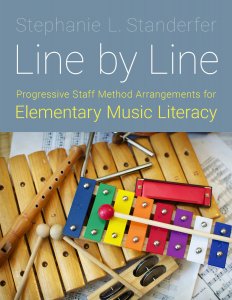
Director of Music Education and Professor of Music Education Stephanie Standerfer, Ph.D. has written a new book, “Line by Line: A Progressive Staff Method for Elementary Music Literacy,” which was released on Sept. 20, by Oxford University Press.
The book is for general music teachers who instruct children of elementary age. Traditional music instruction teaches children symbols without imparting the true meaning of the symbols. Dr. Standerfer said her book calls for students to start learning without ever looking at the musical staff, but rather internalizing rhythmic and tonal concepts before learning to read the symbols. She developed the process through her years of K-12 music teaching, and now teaches pre-service music teachers how to use it.
Many people have visual processing issues with staff, with the horizontal lines sometimes appearing to move, Standerfer noted. So, to teach more effectively, the ideas behind the staff need to be broken down individually, to help create strong neural pathways and understanding for students.
Students taught with the “Line by Line” method hear high and low pitches, and fast and slow rhythms, with concepts introduced slowly. Songs feature two notes, then three, and at the end of the work that includes 36 arrangements, the treble clef is finally introduced. The idea, Standerfer said, is to teach musical concepts in a very sequential manner, preparing children’s ears with sounds before the notation is taught. Parts are sung and then played with instruments, and the method also includes games, compositions and improvisation. Students receive a whole musical experience – they hear, read, sing, and play songs themselves as they step toward developing independent musicianship skills, she said.
“This book takes music literacy beyond decoding pitches and rhythms; it provides music educators with arrangements that are sequenced to provide a foundation for musical skills that lead to meaningful music literacy,” said choral conductor, clinician, and author Carol Krueger in a review of Standerfer’s book. “The step-by-step lessons plans are well-thought out, and include suggestions for composing, improvising, and movement. In other words, it’s a totally integrated curriculum that meets the National Standards. Standerfer has synthesized multiple approaches into a curriculum that is easy to understand and implement, and that every educator will want to explore and integrate into their classrooms.”
She also teaches the method to Shenandoah University music education students, who are now using the ideas in classrooms. Some of the early arrangements for pieces featured in the book were piloted by Loudoun County music teachers, she said. Once all of the arrangements were complete, she had a “playdate” with music education alumni and seniors, who played through every arrangement and gave her feedback on them. “It was wonderful,” she said. So far the book has been well-received by elementary music teachers and music teacher educators.