VR Project Pilot Launch Blends History, Technology
Constitutional Convention Comes Alive Through Virtual Debates
Shenandoah University’s History and Virtual Reality (VR) Design Programs, in partnership with the Shenandoah Center for Immersive Learning (SCiL), held a pilot launch for a virtual reality project that transports participants back in time to the Constitutional Convention in 1787 and the debates that took place there among the founders of the United States.
The launch, held in time for the November elections, was by invitation only and took place on Oct. 29, in the SCiL lab in the lower level of the Health & Life Sciences Building. There, visitors took part in the unveiling of the first part of the multiyear project.
At the launch, visitors donned VR goggles and were subsequently transported to a table in the Assembly Room of Independence Hall in Philadelphia, where the debates at the Constitutional Convention were held. A lifelike virtual Benjamin Franklin, played by a professional voice actor and created by students and faculty, spoke to the visitors about the importance of the convention. Then the participants watched and listened as silhouettes of the founders debated the Constitution.
What we are building, nobody else has done. Instead of reading about history, you get to step into it. This is state of the art.”
J.J. Ruscella, M.F.A. | Executive director of SCiL and associate professor of theater
The project is a collaborative effort by students, historians, computer scientists, virtual reality and audio engineers, and media directors and producers. The project was developed through collaboration between the Shenandoah History Department and the Division of Applied Technology in partnership with SCiL.
The project has been a painstaking one: It took students and faculty around six months to build the three-dimensional virtual Assembly Room in Independence Hall using computer graphics based in part on drawings from the Library of Congress.
“Right now, you can only see the Assembly Room from behind a rope, but this project allows a person to be inside it,” said Mohammad F. Obeid, Ph.D., assistant professor and program coordinator for Virtual Reality Design. “This is the most historically accurate Independence Hall in virtual reality. To have a virtual replica of it is unprecedented. You can’t buy it, you can’t find it online. Shenandoah has created the first.”
Karie Diethorn, chief curator at the Independence National Historical Park, assisted Shenandoah faculty and students with the intricate details of the Assembly Room — from the paint colors to the window treatments and furniture — in order to make the room historically accurate. She said Shenandoah’s project is the first virtual reality request they’ve ever gotten at Independence Hall.
I’ve been so impressed with their commitment to historical accuracy. In addition to their technological expertise, which is profound, they are committed to getting it right. That’s really reassuring and refreshing to me.”
Karie Diethorn | Chief curator at the Independence National Historical Park
The VR Experience: How it Works
The Constitutional Convention enabled the U.S. to transition from the Articles of Confederation to the United States Constitution. Delegates discussed how the United States should be governed, and among their discussions were debates over the creation of the Electoral College.
Shenandoah’s project will happen in five stages — starting with participants being eyewitnesses at the debates in the early stages and developing to the point at which participants can embed themselves in an avatar to debate both contemporary issues and the Constitution with other participants.
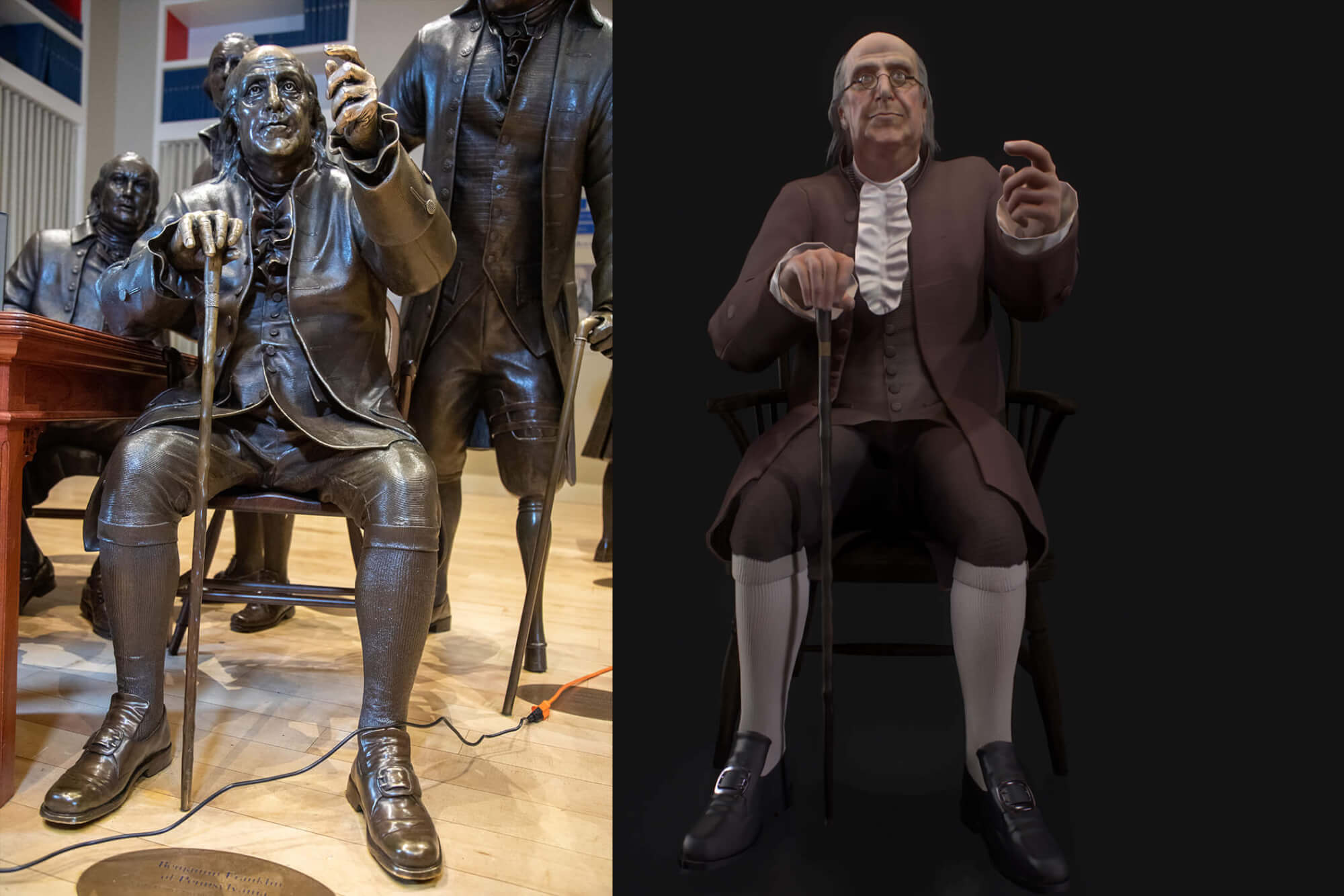
Providing the basis for the experience are CGI-generated avatars based on three-dimensional scans of the founders’ statues at the National Constitution Center. These avatars are voiced by professional actors using scripts prepared by project historians.
We can read about history, we can see it in film, but virtual reality more than any other medium allows us to live in the past and understand it through our own immediate experience.”
Professor of History Warren Hofstra, Ph.D.
The project has been supported and advised by historians at James Madison University, exhibition developers at the National Constitution Center, curators at the National Park Service’s Independence National Historical Park, and by editors at the University of Virginia Press.
Faculty are hopeful the project will be used in college and high school classrooms and perhaps as part of an educational exhibit within the National Park System.