Jonathan Noyalas Publishes New Book About General Philip H. Sheridan
Biography explores the life, death and legacy of a famed Civil War general
By Natalie Gales ’25
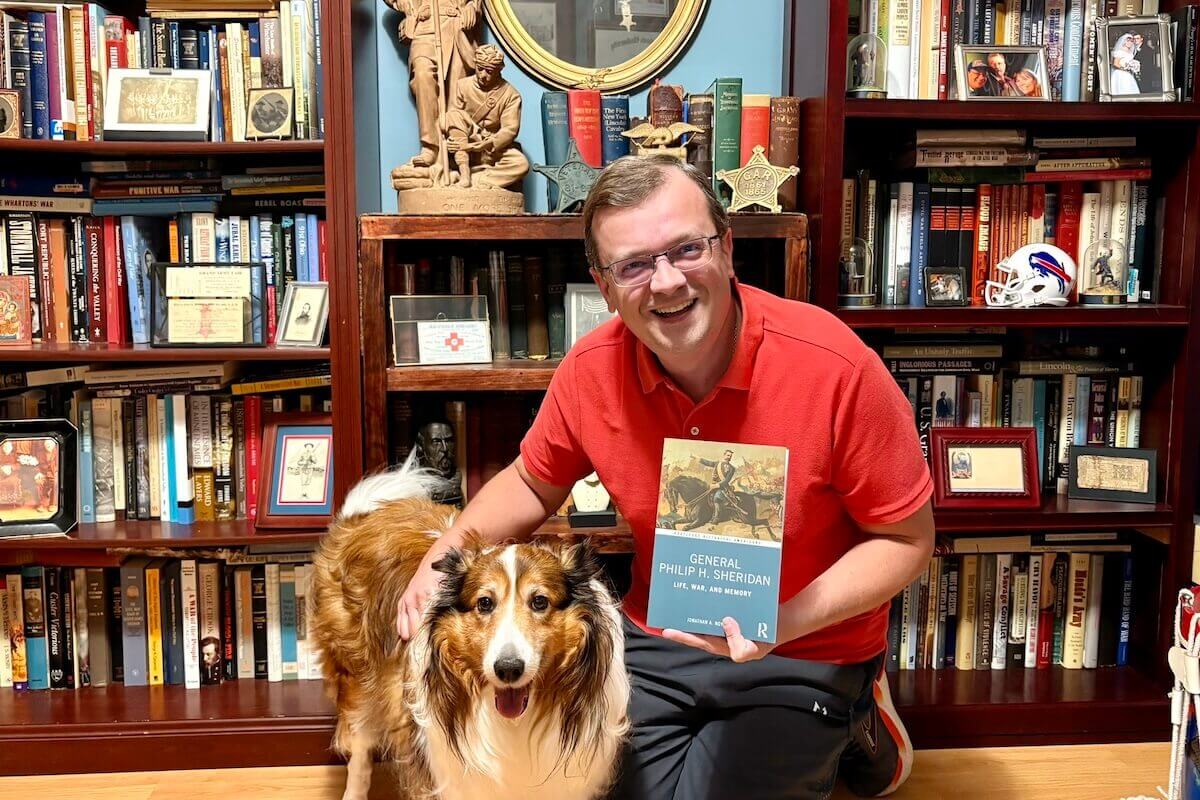
Jonathan Noyalas ’01, M.A., the Hugh and Virginia McCormick Chair in Civil War History and director of the university’s McCormick Civil War Institute, recently published a new book, “General Philip H. Sheridan: Life, War, and Memory.” This is the 17th book that Noyalas has authored, co-authored or edited, and it is his second biography.
Many historians consider Sheridan, a significant figure in the Civil War, Reconstruction and Indian Wars, to be as important as Union generals Ulysses S. Grant and William T. Sherman. However, whereas Grant and Sherman have been the subject of numerous biographies, Sheridan is often overlooked.
“It has been more than a decade since the last serious biography of Sheridan appeared,” Noyalas remarked. “I wanted to write this book to help people gain a deeper understanding of the complexities of Sheridan, someone who is undeniably a polarizing figure in American history.”
In the biography, he writes that Sheridan was “both a hero and a villain… a liberator and an oppressor, a compassionate commander and a vengeful superior — a mass of contradictions.”
Indeed, Sheridan was a controversial figure throughout his life and following his death, most notably for his campaign of destruction in the Shenandoah Valley in the autumn of 1864, the Burning, and his mistreatment of Indigenous peoples.
At the same time, he was not a static figure. A prime example of this was Sheridan’s shift in perspective regarding Black suffrage. While he didn’t always believe in the cause, he became a large proponent of Black political rights after the Civil War. In this way, Sheridan’s story reflects the human ability to evolve and grow over time.
“General Philip H. Sheridan” also stands apart from earlier Sheridan biographies due to its roots in years of primary research. Noyalas includes source material that previous authors did not use, allowing for a more in-depth approach to the general’s legacy.
Noyalas hopes that upon finishing the book, readers — whether they be historians, history students or anyone interested in Sheridan — will develop a more complex understanding of the biography’s subject.
Whether you love Sheridan, despise him, or are somewhere in between, there is no denying that an examination of his life reveals much about the Civil War, Reconstruction, the Federal government’s wars against Indigenous peoples, and historical memory. I did not write this book to praise Sheridan, nor condemn him, but to tell the story of the complexities of his life, what that life reveals about broader themes in American history in the mid-19th century, and the role that historical memory has played in shaping our understanding of Sheridan.
Jonathan Noyalas
To learn more, check out Jonathan Noyalas’ “General Philip H. Sheridan: Life, War, and Memory,” available through Routledge.