Shenandoah University Hosts First Story-Driven Cyber Defense CTF Challenge
Students from SU, Laurel Ridge and a local high school compete in cybersecurity event
By Samantha Scott ’27
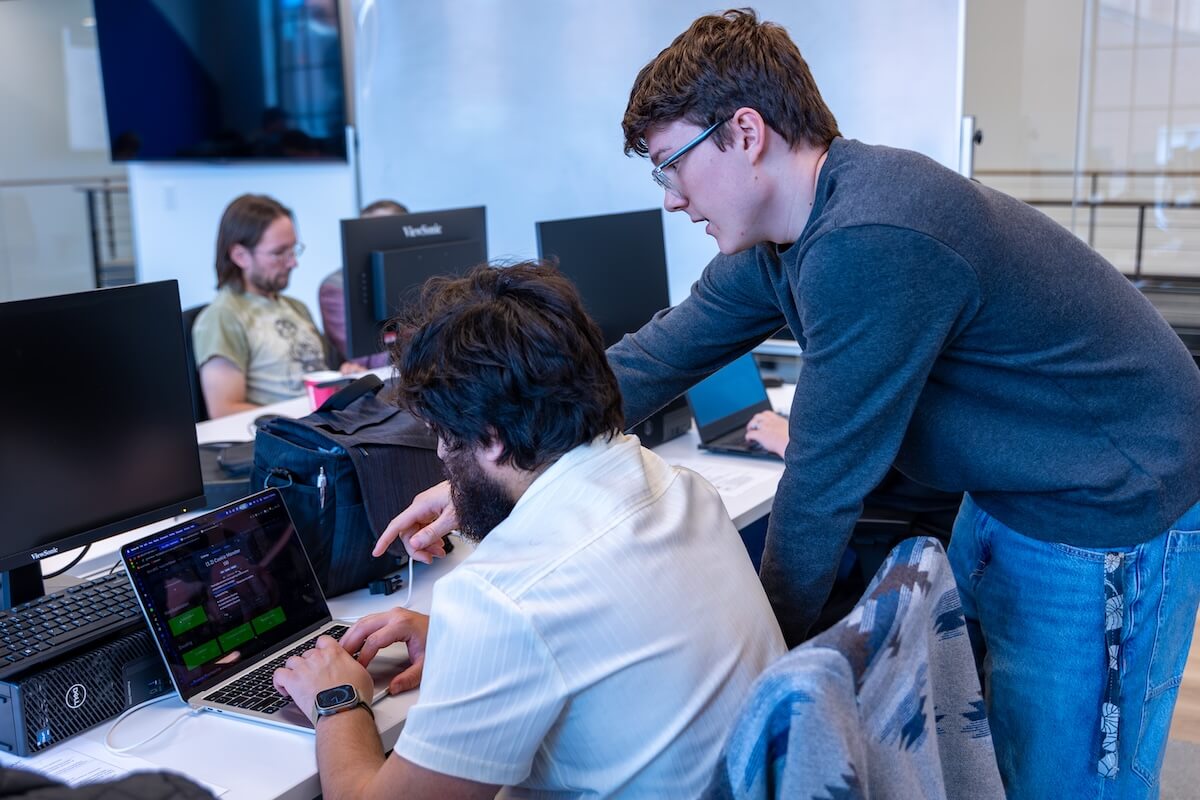
On Saturday, Nov. 7, Shenandoah University’s School of Engineering & Technology hosted its first ever Story-Driven Cyber Defense & CTF Challenge in the Hazel-Pruitt Armory.
In this free capture-the-flag competition, which was run by Shenandoah’s cybersecurity program and was open to all students, participants solved hands-on cybersecurity puzzles to uncover hidden “flags,” which served as the answer needed to move on in the competition.
Competitor and SU student Addie Mack ’29 said these “flags” were found by applying security tools and techniques to locate them among raw data, network traffic and web applications. These flags allowed students to earn points on a live scoreboard.
In order to discover these flags, Mack, who is pursuing a Bachelor’s of Science in cybersecurity, explained that competitors had to sort through the noise to locate patterns, inspect HTTP response headers and exploit vulnerabilities such as SQL injection. Each flag – a string hidden among the different data sets – acted as proof the challenge had been completed successfully.

Designed to be beginner-friendly, this event welcomed students with varying levels of experience, with more than a third of competitors trying cybersecurity for the first time. In total, 18 competitors met up. Students from Shenandoah University and Laurel Ridge Community College, as well as one student Warren County High School in Front Royal, Virginia, spent the day solving cybersecurity challenges in cryptography, web security and digital forensics, all connected through a central storyline.
Shenandoah Professor of Cybersecurity Suhaib Obeidat, Ph.D., explained that CTF challenges are typical events employers and the cybersecurity community use to spot talent, which can lead to future internships and job interviews for students.
Stuart Jones ’28, who is also pursuing a B.S. in cybersecurity, said his favorite puzzle was “where a compromised computer was sending a link to malware in chunks through queries.”
Jones and Mack both attended Laurel Ridge Community College’s CTF event in October, where Jones won first place.

Mack praised the amount of skills implemented at SU’s CTF, explaining that competitors decrypted hidden messages, broke ciphers and exploited weak encryption algorithms. Competitors exploited vulnerabilities in websites and analyzed packet captures to then isolate malicious IP addresses executing brute-force attacks. In addition, the event incorporated ethics, leading competitors to work only on authorized systems, which is the same standard professionals follow.
Later at the event, SU alum Peyton Hall ’25, a cybersecurity specialist at Computer Packages Inc., spoke with participants about moving from SU into the field and shared advice on getting started in a cybersecurity career.
This event was held in the cyberlab in the HIVE and organized by Dr. Obeidat and Shenandoah Assistant Professor of Cybersecurity Michael Fagan, Ph.D., with help from SU students and CTF competitors Spencer Leeman ’28 and Wyatt Ballenger ’28.
The competition recognized the following winners:
- First Place: Tyler Smith, Laurel Ridge Community College
- Second Place: Stuart Jones, Shenandoah University
- Third Place: Addie Mack, Shenandoah University
Four competitors reached the top score of 6,250 points; ties were decided by how quickly each student completed the challenge.
Mack and Jones won a microcontroller, specifically a Raspberry Pi Pico W, for placing on the podium.

Overall, the event received positive feedback from participants, with several students telling organizers it was the most fun they’d had in a while. Initial post-event survey feedback has been positive, with comments including “I do appreciate the theming across all of the questions as opposed to being a bunch of unrelated ideas,” and “The professors that set up the CTF were very helpful and if there was an issue with one of the challenges they were quick to fix it.”
Jones and Mack were some of the competitors giving positive feedback, with Mack stating that she feels “much more comfortable using commands such as ‘grep,’ ‘awk,’ and ‘curl’ to filter log files, trace network requests, and test web endpoints.” Mack enjoyed that this event allowed her to “use skills learned from various classes within a hands-on environment.”
“It was interesting to see concepts from class discussions play out in real time,” she added, stating that the competition also provided hands-on experience that is useful for building her resume. “I think it shows employers that you truly care about the topic and have the experience to do the job well.” Jones agreed, saying that this event will look great on his resume for IT recruiters.