Testing the Waters
Shenandoah University faculty-student research project traces the progress of an invasive species through its presence in and around Abrams Creek
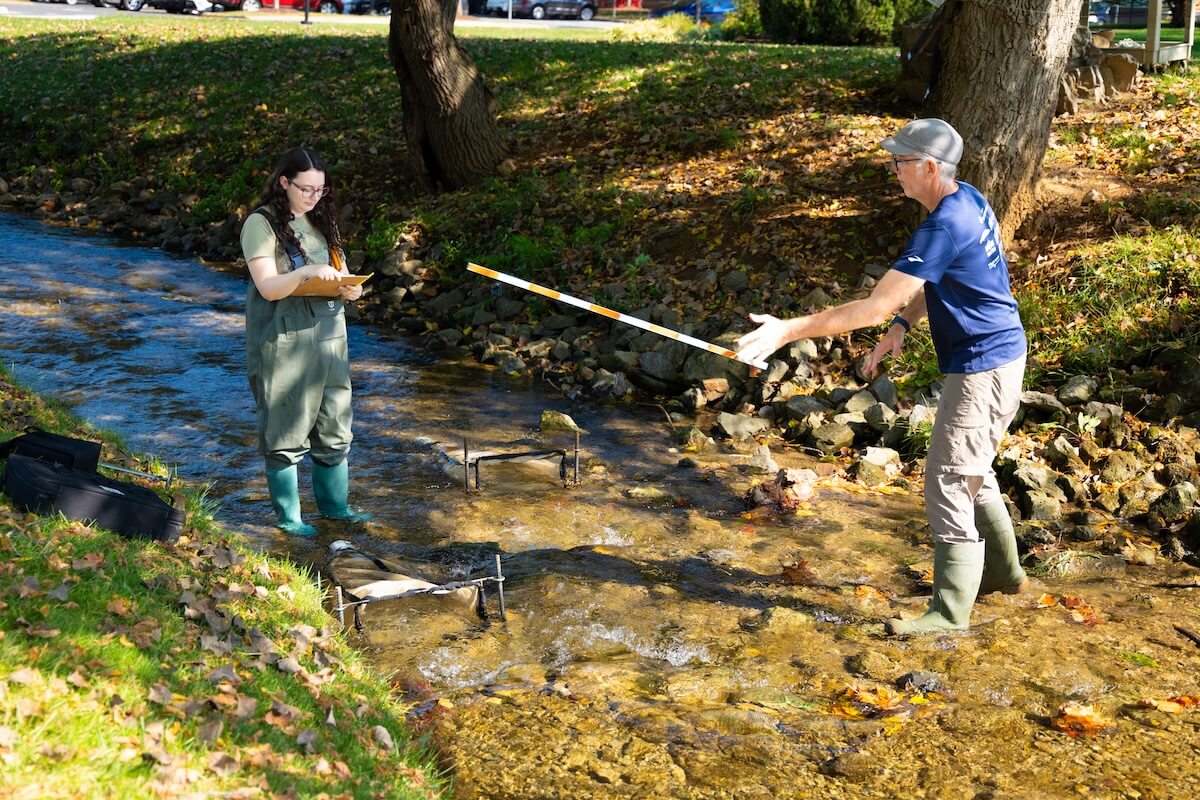
Just after noon each Friday during the Fall 2026 semester, anyone walking or driving along Abrams Creek on and around Shenandoah University’s main campus can see research in action as Assistant Professor of Environmental Studies Darrin Hunt, Ph.D., and environmental studies major Grace Bowman ’27, both clad in hip waders or boots, sample the waters to research the advance of invasive spotted lanternflies.
A scientific story flows through campus
Dr. Hunt and Bowman first started talking about conducting research together when she was in his freshwater ecology class, and he suggested they use some equipment he had for monitoring cicadas to instead investigate the presence of spotted lanternflies at all stages of their development, both in the water and on nearby land.
The pair set up three testing areas for both water and land to determine the progress of the lanternflies. “Grace’s sampling effort was 20 weeks,” Hunt said. “That is a lot of data for an undergraduate researcher. Over this time period, from May to November, she has detected all spotted lanternfly developmental stages in the river drift of Abrams Creek.”
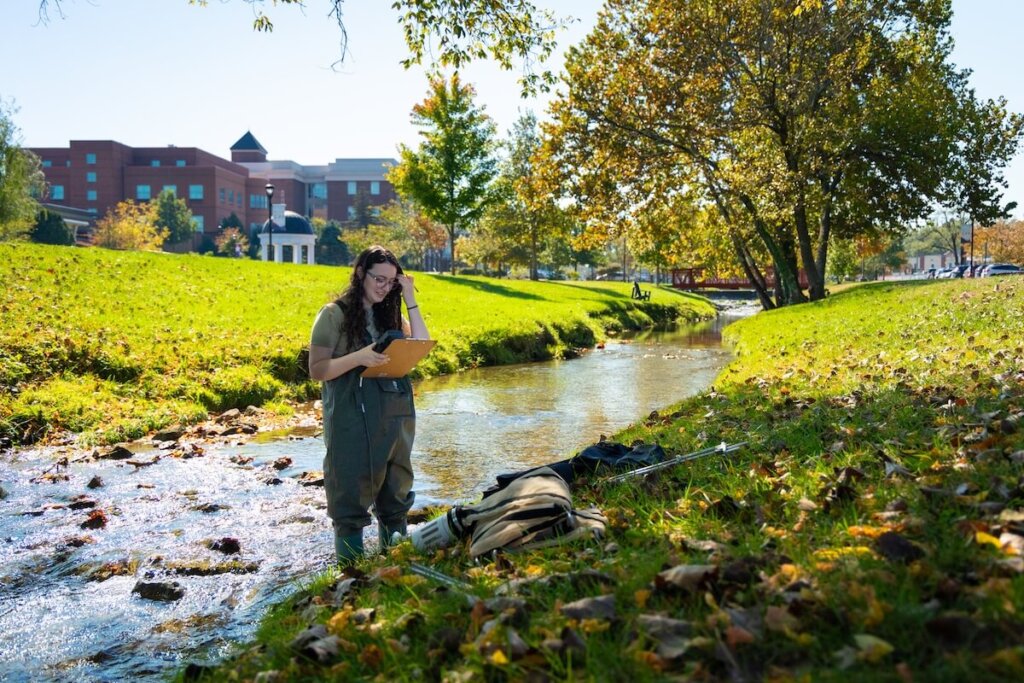
“I’ve really enjoyed having more hands-on experience, with working with the tools and collecting data,” Bowman said as she took samples from the creek on main campus. “That kind of regular regimen will help me look forward to something similar along the lines towards a career.”
What does this research mean?
Seeing more of the insects within the water’s drift than on land at the sampling sites could indicate a denser concentration of the insects further upstream, Hunt said.
In the midst of the project, Hunt was able to purchase an OTT MF Pro flow meter with funds awarded from the Provost’s Faculty Development grant. “This meter can determine the current velocity of any point in flowing waters with granular detail,” he said. “For each of our sampling events, we install three drift nets for one hour. This meter allows us to determine the current velocity directly in front of each net, and we can calculate the volume of water moving through each net for the hour they are installed. We then can calculate the number of spotted lanternflies per liter for each net, site and sampling event.”
Preserving ecosystems
“Being able to conduct research at Shenandoah means so much to me, as it allows me to apply my interests and gain familiarity to fieldwork. I appreciate having the opportunity to contribute to research that can help us understand how invasive species, in this case spotted lanternflies, interact with our local environment,” said Bowman, who originally transferred to Shenandoah as an animal health and science major. “After attending a few campus events around ecology and conservation, I felt called to swap my major to environmental studies with a concentration in conservation. I want a career path where I feel more involved and feel like I am doing something fulfilling. Preservation of ecosystems feels more important than ever,” she said.
She’ll get a chance to gain even more experience in the field in the new year, if she chooses. “We will expand this project to a larger geographic range, looking not only at Abrams Creek, but also Pigeon Hollow Creek at the Cool Spring Campus and in the Abrams Creek Wetland Preserve,” Hunt said. “We will also be looking into whether game fish are using spotted lanternflies as a food resource, and if so, does this change by developmental stage or season.”