Shenandoah University Sustainability Facts
Educating and inspiring others to reduce, reuse and recycle
What makes Shenandoah University a sustainable community? Here are a few facts that demonstrate our commitment to educating and inspiring others to reduce, reuse and recycle with an emphasis on the related human impacts to the environment and making small changes that can make a big impact.
Sustainability Facts
- Shenandoah was recently selected from 2,000 Colleges & Universities for the Princeton Review’s 2017 “Guide to 375 Green Colleges.”
- 36 solar panels added to the James R. Wilkins, Jr. Athletics & Events Center
- Gore Hall, a residence hall, is capped with a “green” roof.
- Dining services uses compostable products and promotes the use of reusable water bottles.
- Shenandoah’s dining halls went trayless in fall 2012, reducing water and energy usage as well as food waste.
- The student group, Campus Kitchen at Shenandoah, repurposes unused food from Allen Dining Hall to give back to the Winchester community, aiding in the fight against hunger.
Recycling
- 300,000+ pounds of materials recycled during the 2016/17 academic year.
- Recycling bins are placed throughout campus, with about 100 new bins added within the past two years.
- Shenandoah’s Bulk Mail department purchases printing and copying paper with a minimum of 30% post-consumer recycled content. This helps close the loop on the recycling process.
- Shenandoah Greenworks swap shop collects more than 5,000 pounds of items every year, eliminating this much waste from entering the landfill. Donated items include gently used furniture, working appliances, small housewares, lamps, electronics, usable clothing and non-perishables, and unopened food items collected in designated locations, The swap shop redistributes the items, for free. Items not claimed or repurposed are donated to local non-profit organizations.
Environmental Stewardship
- There are 78 trees in the quad on main campus.
- The Chesapeake Forests Program has planted 600 trees at Cool Spring.
- The water features at Sarah’s Glen serve to filter rainwater before it flows into Abrams Creek
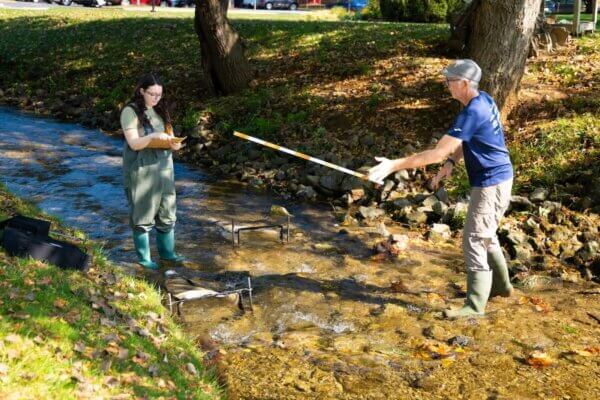
- The 195-acre Shenandoah University River Campus at Cool Spring Battlefield serves as a learning laboratory where students can conduct research in the humanities and the natural sciences. The site, abundant with natural features, includes a heron rookery.
- Many of the plants, flowers, and trees on Shenandoah’s campus have been labeled to promote environmental stewardship, education, and research. These plants are selected as native and non-invasive species.
- In 2015, Shenandoah eliminated a section of ground cover (invasive English Ivy) on a patio near the Allen Dining Hall.
- While this garden produces only a small amount of vegetables, its co-location to the Dining Hall helps remind us of our connection to the food we eat.
- This garden has produced squash, strawberries, peppers (both sweet and hot), tomatoes, flowers, kale, cabbage and spinach.
- In addition to this small garden, in 2013 the Student Environmental Council planted an organic herb garden for use by the kitchen staff and other community members.
- The herb garden produces oregano, thyme, chives, lavender, and Russian sage. Among other landscaping on campus is the Serviceberry or Juneberry shrub, which produces delicious berries every summer.
- During the summer of 2012, Shenandoah began collecting and composting its own yard waste in a facility located on the edge of campus.
 Water Conservation
- McKown Plaza behind the Brandt Student Center features permeable pavement.
- Campus dishwashers and washing machines were replaced with Energy Star rated units in 2014. These units not only use less energy but also less water. The estimated savings from the washing machines alone is 1,519,000 gallons of water and $11,734 per year.
- Of all the developed landscape at Shenandoah, none of it is irrigated. Shenandoah’s planting plan includes choosing plant species that are low maintenance and require no regular irrigation. Why is this important? In a typical household, landscape irrigation accounts for up to half of all water consumption. At the university, this could translate to hundreds of thousands of gallons of water.
- Numerous plumbing fixtures have been replaced with low flow models including toilets, showerheads and faucets. The majority of toilets are now 1.6 gallons per flush or lower.
Energy Conservation
- 24 bike racks on campus to encourage the use of bicycles on campus
- Occupancy sensors are used to reduce energy consumption when spaces are not in use.
- Energy-efficient lighting fixtures reduce the amount of energy needed to light buildings. LED lighting is used in a wide variety of campus spaces, including the house and stage lights at Armstrong Concert Hall. LED bulbs use 20 percent to 25 percent of the energy of incandescent bulbs, and last longer than incandescent, as well.
- The Heating Ventilation and Air Conditioning (HVAC) systems have advanced control options that respond to outdoor conditions and building schedule to conserve energy and improve air quality.
- Shenandoah University currently operates 5 electric golf-car-type vehicles in support of Student Engagement, Athletics and Physical Plant operations. Electric vehicles have no tailpipe emissions.