Ready For Liftoff
Two Shenandoah Students Attend NASA Workshop, Build Payload To Be Launched Into Space
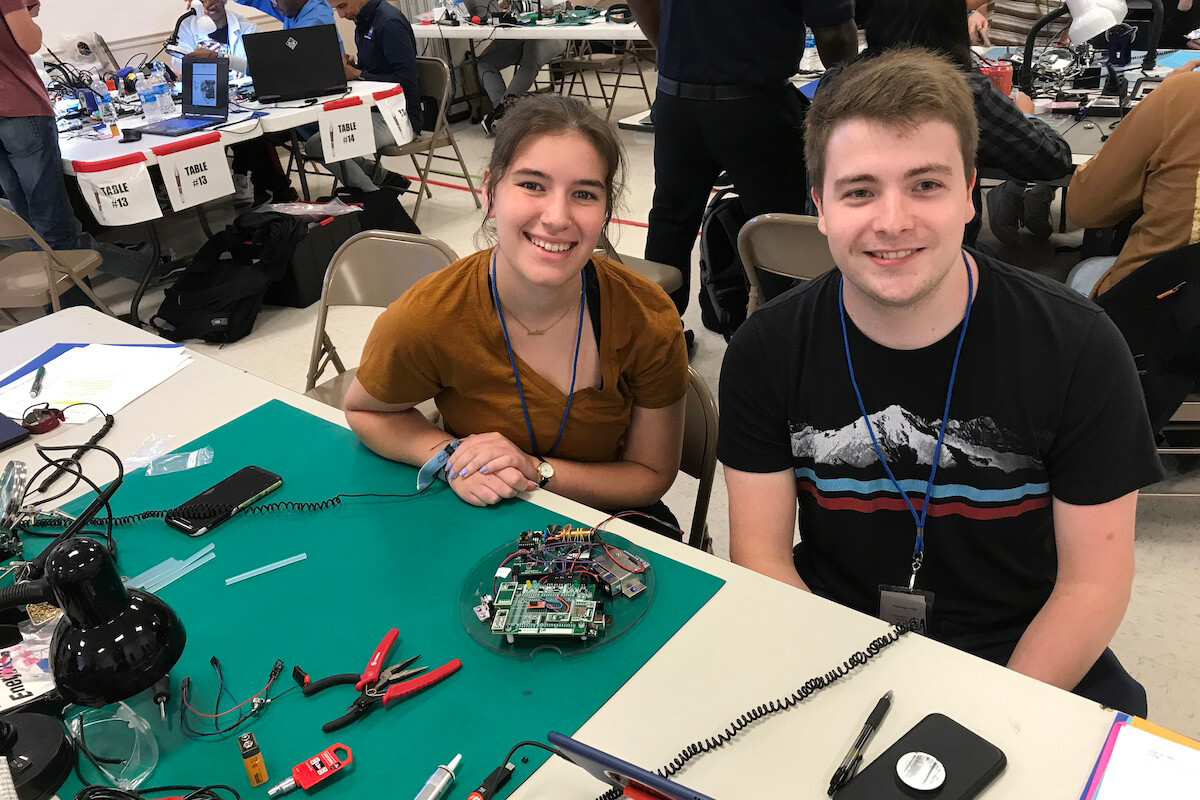
Two Shenandoah University students were among a select group of their peers from across the country to participate in NASA’s RockOn program at Wallops Flight Facility, a rocket launch site located on Virginia’s Eastern Shore.
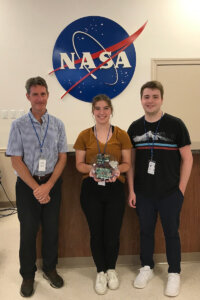 Shannon Eissele ’24, a biology student at SU, and Connor Hill ’26, who is double majoring in computer science and data science and applied mathematics, teamed up to take part in the weeklong student flight program, during which students construct payloads that are launched on a sounding rocket into suborbital space and are later retrieved to analyze the data they collected during the flight.
Eissele and Hill were one of 28 two-person teams composed of students from colleges and universities throughout the U.S. Shenandoah University Director of the Division of Applied Technology Ralph Wojtowicz, Ph.D., was the SU team’s faculty mentor at RockOn.
Shenandoah was one of 40 institutions to apply for this year’s RockOn program. Dr. Wojtowicz said the selection of Eissele and Hill to represent SU came at the recommendation of faculty in Shenandoah’s Division of Applied Technology.
The experience served as a fitting prelude to the launch of Shenandoah’s new engineering program in Fall 2023.
As we developed the university’s new engineering program, we recognized the importance of integrating hands-on project experiences. The RockOn workshop has provided us with specific project ideas to include in courses, knowledge that will help us become involved in other NASA programs such as RockSat-C and RockSat-X, and connections for securing student internships. I expect hands-on, space-related experiences will become important components of many of Shenandoah’s science and technology programs. The RockOn workshop also demonstrated that our students can excel and have fun working in this field.”
Ralph Wojtowicz, Ph.D., Shenandoah University’s director of the Division of Applied Technology
The weeklong experience at RockOn, now in its 15th year, typically ends with a bang – or a blast, in this case – as students’ experiments are launched via a sounding rocket to an altitude of over 70 miles before returning to Earth and being collected from the Atlantic Ocean. This year, however, unfavorable conditions on and around Wallops Island in Accomack County, Virginia, snuffed out the launch that was originally scheduled for June 22 and was postponed three times.
 The launch was rescheduled for Aug. 15, and Wojtowicz said Eissele and Hill intend to return to Wallops Island to watch their experiment blast off.
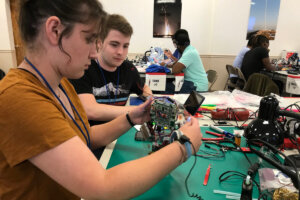
Although they’ll have to wait to see the results of their efforts, Eissele and Hill still learned plenty during the weeklong program. Neither had any experience soldering or building circuits prior to RockOn, and Wojtowicz commended the students’ “tireless” and “flawless” work on constructing a complex payload circuit that included a particularly challenging 1,000-volt Geiger counter component to measure radiation.
The payload students built consisted of a variety of sensors, a microcontroller to run the sensors and write data to an SD card, and a battery power source. In addition to the Geiger counter, the payload included an accelerometer and inertial measurement unit (IMU) for measuring motion and magnetic fields; temperature, pressure and humidity sensors; and circuitry for automatically powering on the payload at liftoff. After multiple tests and inspections of the payloads – and the collection and processing of test data – the experiments were integrated into the sounding rocket by NASA engineers.
When I was first approached with this opportunity, I knew I had to do it because I have always been interested in all things space, and I am so glad that I did it. The one aspect that I was a little concerned about was the fact that I did not have any experience in this area. What I think is one of the most amazing things about this workshop is that the participants truly needed to have no prior experience in an area that is not directly related to my major. That being said, many of the participants did have a background in or aerospace, and I had a great time talking with and learning from them about their past projects and ideas for new ones.”
Connor Hill ’26, Shenandoah University student
After the rocket is launched and recovered, the SD card, data collected and payload will be returned to students for future educational activities.
NASA’s RockOn program is designed to help participating institutions prepare for its more advanced student flight programs – RockSat-C and RockSat-X – and Eissele and Hill have already begun brainstorming ideas for a future RockSat-C project.