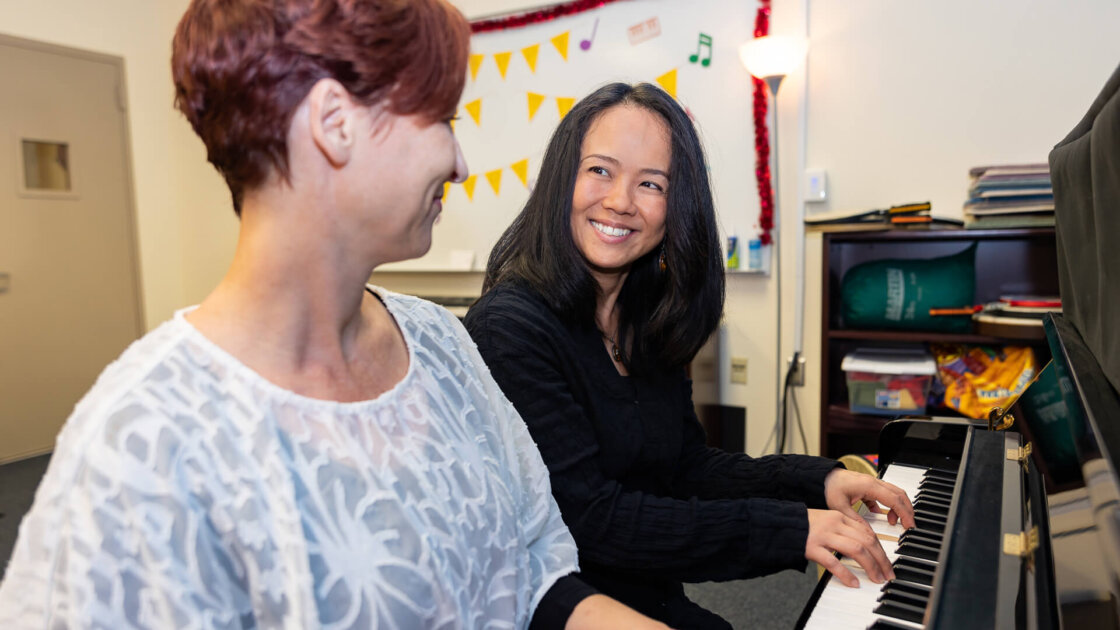
Music Therapy Equivalency Program
Let your passion for music serve others.
Shenandoah’s Professional Studies Program for Music Therapy Certification Eligibility is a graduate equivalency program that prepares you for practice as a Board Certified Music Therapist (MT-BC). As an approved program of the American Music Therapy Association and National Association of Schools of Music, it is perfect for students with a bachelor’s degree, skills as a musician, and an interest in working with people using the transformative power of music.
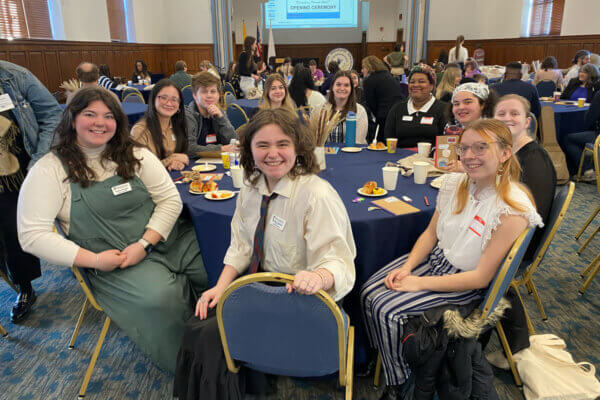
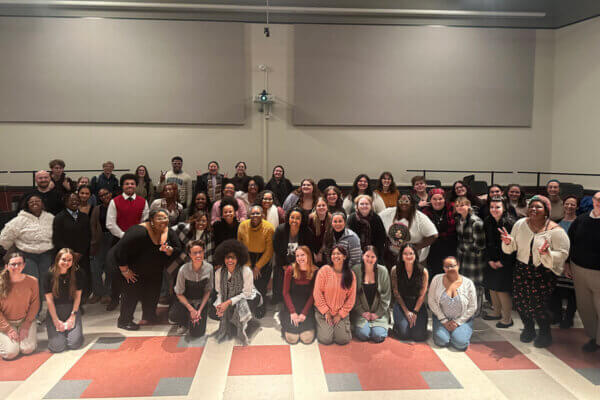
Celebrating our 50th year in 2025, our two-year, full time graduate program allows you to develop your skills and clinical expertise in a supportive, creative learning environment. Our comprehensive course of graduate-level study (39 credits) is especially designed for people who hold an undergraduate degree in music or a related field (e.g., music education, psychology, liberal studies, etc.) and wish to become Board Certified Music Therapists (MT-BC). You’ll meet for classes on campus two days a week, work in small, closely knit cohorts, and gain direct clinical experience, including a full-time internship.
Students completing the Professional Studies Program for Music Therapy Certification Eligibility come from a wide range of backgrounds. Some students have a music degree, some a psychology degree, and others a biology or history background. What all have in common is the goal of growing as musicians and using their music skills to serve others.
Students completing the Professional Studies Program can also transition into the Master of Music Therapy degree during fourth semester (internship), completing the Master’s program in an additional three semesters.
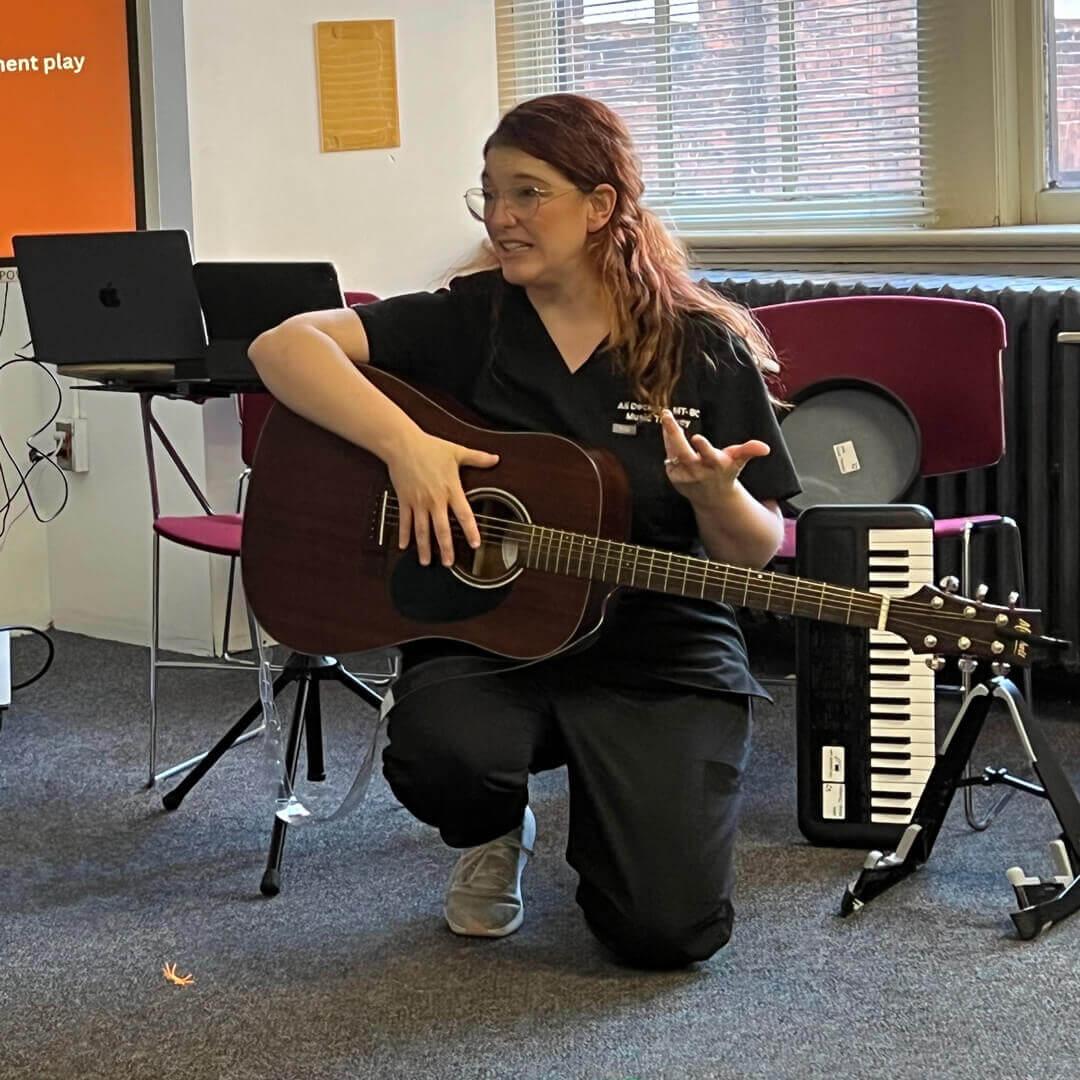
The graduate Professional Studies Program for Music Therapy Certification Eligibility not only prepared me practically for the day-to-day work of being a music therapist, but also supported the expansion of my imagination for what work in a therapeutic field could look like. Through the classes, course materials, clinical practicum experiences, and mentorship from the incredible and compassionate professors in the program, I felt prepared to step into the role of a music therapist with the tools necessary to grow into my own therapeutic identity and location, for the good of the wonderful humans with whom I get share connection with in music.”
– Ali Deckard ’24, MT-BC
Music Therapist, Johns Hopkins Center for Music & Medicine
Music Therapist, A Place To Be
Learn more about the professional studies program in music therapy at shenandoah
Music therapy helps clients to develop skills, adapt behavior, and overcome obstacles in their lives. Music therapists use different kinds of music experiences, such as singing, improvising, songwriting, and listening to and talking about music, to meet clients’ needs using the unique relationship between client, music and therapist. Music therapists are creative, compassionate, thoughtful people.
Music therapy is goal directed, and music therapists learn skills in the assessment-treatment-evaluation process that allow them to work effectively with a broad range of clients. Depending on the setting, you work as part of an interdisciplinary team, alongside colleagues such as doctors, nurses, teachers, and physical therapists.
Music therapists work in a wide variety of settings that include schools, hospitals, psychiatric facilities, aged care facilities and hospices. Some settings, like aged care, tend to emphasize group work, whereas other settings, like hospitals and hospice, tend to emphasize individual work.
A board certified music therapist (MT-BC) is an individual who has successfully completed the nationally accredited Board Certification exam, demonstrating the knowledge, skills and abilities necessary to practice professionally.
To learn more about the Professional Studies Program, or if you have questions about your eligibility for the program, please feel free to contact Dr. Meadows directly at anthony.meadows@su.edu.
Shenandoah University’s music therapy program has over 50 affiliated internship sites in addition to National Roster sites approved by the American Music Therapy Association.
Students complete a total of 1,200 hours of clinical work that includes a 6-month full-time internship in which they work directly and intensively with clients under the supervision of a music therapist. Through mentorship, students are guided into a setting of interest (e.g., hospital, school or private practice) and supported by faculty through the application process, remaining in contact with faculty throughout their internship.
Students who complete this program, and pass the Board Certification exam, work as music therapists (MT-BC) in a range of settings, including schools, hospitals, mental health facilities, hospice and private practice.
The American Music Therapy Association (AMTA) provides annual salary data for music therapists, updated each year and available online for review (see annual workforce analysis data). In 2024, the average salary for a music therapist was $66,731. The average salary for a music therapist in Virginia was $56,405.
Classes are held on main campus on Mondays and Wednesdays for the first three semesters of the program. In fourth semester, students complete a six-month, full-time internship. Working in cohorts of 8-12 students, classes combine theory and research with hands-on practical knowledge and skills. You work on assignments that develop your understanding of how to implement music therapy activities and experiences, and how to understand the complex needs of clients.
An interdisciplinary focus is included. Students complete an Interprofessional Education (IPE) workshop series with students in graduate health professions programs, along with specific program-to-program Interprofessional Practice (IPP) events. This can include co-treatment clinical experiences and clinical simulations that build interprofessional communication skills and understanding.
The Professional Studies Program in Music Therapy Certification Eligibility is a graduate equivalency program intended for students who plan to work as Board Certified Music Therapists (MT-BC). Students complete courses in music therapy clinical foundations, clinical musicianship, and 1,200 hours of clinical training in order to be eligible for the board certification exam, which is administered by the Certification Board for Music Therapists (CBMT). Students apply for the board certification exam after successfully completing all academic and internship requirements, including any foundational music courses identified by the Director of Music Therapy during the interview/audition process. CBMT administers the board certification exam, which is completed by students independently of their studies at Shenandoah University.
The MT-BC credential is a national credential recognized by the state of Virginia. While nationally recognized, some states also require a license to practice. Students should consult with the American Music Therapy Association website for specific information on state licensure and recognition requirements should they wish to practice in another state at www.musictherapy.org/policy/stateadvocacy.
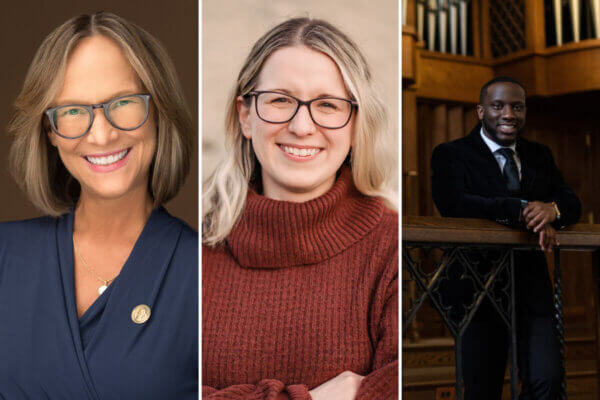
Shenandoah’s music therapy program is the oldest in Virginia, with a rich history of clinical preparation and research by students and faculty. Undergraduate and graduate classes are taught by a team of 10 faculty members, across four degree and certification programs. Our graduate teaching faculty include:
Dr. Tony Meadows, MT-BC, LPC, FAMI, is Director of Music Therapy, advises all graduate students, and teaches in both the undergraduate and graduate programs. He is a GIM Fellow, Licensed Professional Counselor, and has more than 20 years of clinical experience. Dr. Meadows has published extensively in the field.
Dr. Bronwen Landless, PhD, MT-BC, has twenty years of clinical experience in a variety of psychiatric and community settings. With core values of belonging, well-being, and access at the center of her teaching, Bronwen facilitates collaborative teaching and learning communities in both the undergraduate and graduate programs. Her research, practice, and teaching are grounded in anti-oppressive, resource-oriented, and community music therapy approaches.
Applicants must have completed an undergraduate degree in music or a related field (e.g., music education, psychology, etc.), with a minimum grade point average of 3.0 (on a 4.0 scale). Students interested in applying to the program who do not have a music degree are encouraged to contact Dr. Meadows at anthony.meadows@su.edu to discuss music core requirements. In order to be admitted into the graduate music therapy program, you must be admitted into the Shenandoah Conservatory and pass the audition/interview.
The interview process is 45 minutes and divided into two parts. In the first part (the audition), applicants sing and play a total of four songs on piano and guitar (two each) demonstrating their current level of musicianship. Applicants choose a range of styles that reflect their interests and skills, including children’s songs, pop, folk, show, jazz, blues and traditional music. One original song can be included in the audition materials. Applicants can elect to perform a piece on their primary instrument if they wish to include this as part of the audition process – this is optional, and not required for the audition.
In the second part of the audition (the interview), you will be asked a range of questions about your interest in music therapy, your background experiences, goals, readiness and general knowledge of the field. You will also be given the opportunity to ask questions about the program.
Scheduling an Audition
Auditions are scheduled in one of two ways:
- During one of the scheduled virtual or in-person audition days held in spring semester of each academic year, or
- By individual arrangement when the application occurs outside of scheduled audition days.
| Job Title | Cohort Number of graduates | Number of Students Graduated On Time | On Time Graduation Rate |
|---|---|---|---|
| Music Therapist | 8 | 8 | 100% |
| Length of Program | Credits | Credit Hour Average Tuition | Program Tuition |
|---|---|---|---|
| 2 years | 39 | $500.00 | Approximately $22,035 plus professional core, music skills lessons and conservatory fees* |
*Students also need to complete up to an additional 15 professional core credits and take up to three semesters of piano, guitar and voice lessons, depending on skill level.
| Books $45 per credit/Supplies | Program Median Loan Debt |
|---|---|
| $1,350.00 | 0 |
Students who come into our graduate music therapy program are looking to combine their love of music with a desire to help others. They can be music therapists (MT-BC) seeking to advance their knowledge of theory, research and clinical practice or students with an undergraduate degree in music or a related field seeking to enter the field of music therapy. Both are typically interested in psychology and may also be interested in medicine and/or philosophy.
Being intellectually curious is very important. Having the desire to open yourself to new concepts, theories and ideas is essential in your development as a music therapist, as are your writing and critical thinking abilities.
Being a competent musician is also very important. Understanding how to reach others through singing and playing, improvising and moving to music means that you need to be well-rounded musically. During your training you develop guitar, piano and vocal skills in a range of styles such as rock, hip-hop, folk, country, oldies, children’s songs and sometimes even your own compositions.
Finally, being in good mental and physical health is very important. In order to serve others, you need the motivation, maturity and creativity to work with people who desire a wide range of outcomes. This means growing and adapting to different settings and people, being open to supervision and feedback, and having the emotional capacity to “be there” for someone else. The best therapists are often those people who have used music to transform themselves—they know first-hand what it’s like to use music therapeutically, and what it’s like to overcome life’s challenges.