Making the Most of Summer With Research
Arts & Sciences Summer Scholars Program leads to a book, podcast, and so much more
Over the summer, with many holding down part-time jobs, a group of Shenandoah University students, overseen by faculty, conducted wide-ranging research as part of the College of Arts & Sciences Summer Scholars Program, for which students can also earn credits.
Introducing Virginia Mysteries
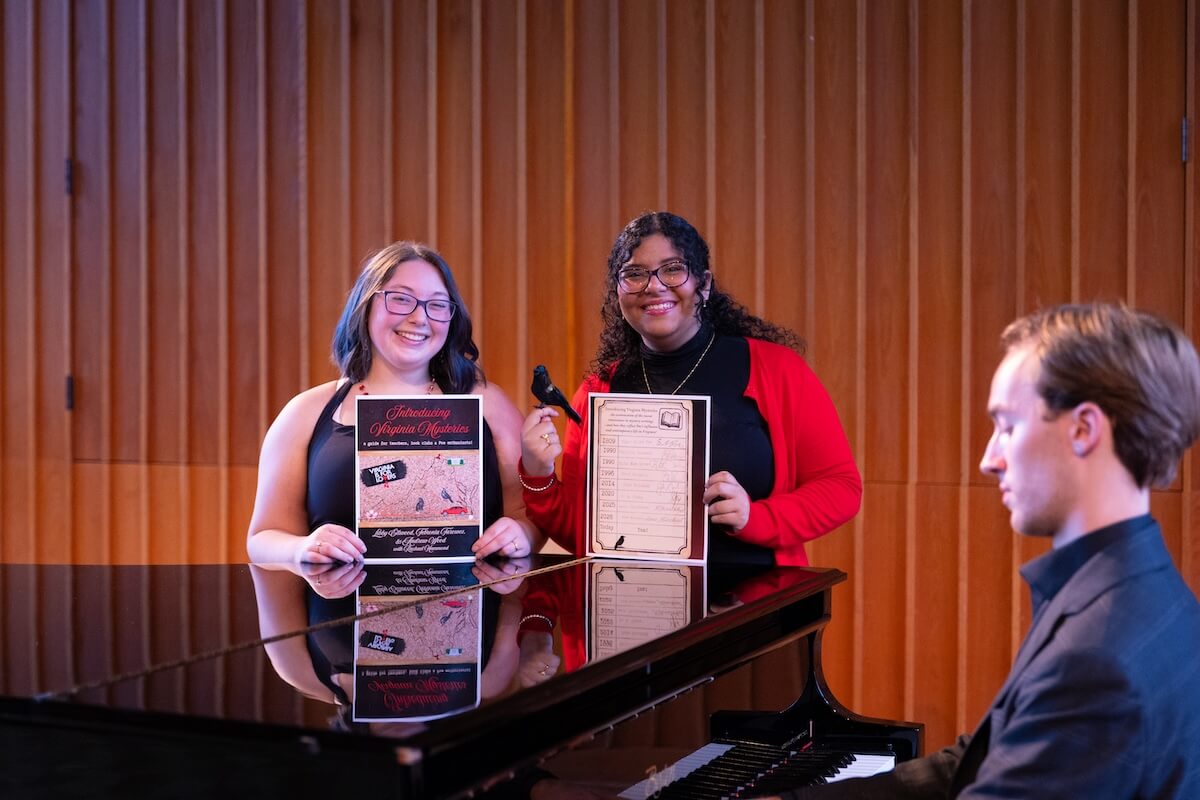
Febronia Farowez ’28, Elizabeth “Libby” Ellwood ’29, and Andrew Wood ’28 formed their trio at the suggestion of English Lecturer Rachael W. Hammond, M.A. Their project, called “Introducing Virginia Mysteries,” considers the idea that a renaissance in Virginia mystery writing began around 1990. The project also explores how Edgar Allan Poe’s legacy lives on in these writings. The scholars read eight novels, wrote a 250-page book resulting from their research, composed literarily informed music, and produced a podcast about their project.
A love of Poe’s work, as well as an English major, connects the three students. Farowez and Ellwood are also secondary education double majors, while Wood is combining his English studies with a piano performance major.
Interviewing experts and renowned mystery authors
The group interviewed authors like Patricia Cornwell, known for her Richmond, Virginia-set Kay Scarpetta forensic mysteries; S.A. Cosby, who hails from Southeastern Virginia; Richmond-born, Fairfax County-resident David Baldacci, whose novels include “Absolute Power,” which was turned into a 1997 film starring and directed by Clint Eastwood; Shenandoah graduate Heidi Christopher ’12, whose first novel, “Lies the Dirt Keeps” was published in late 2025; and retired Shenandoah faculty member Anne Marchant, whose works feature the Shenandoah Valley; as well as legal, security, historical, airport operation and forensic science experts. They also visited sites, such as the Library of Congress and the UVA Special Collections Library, to explore their hypotheses.
Personal growth through research
Farowez said the process of conducting the research improved her appreciation of poetry, which she didn’t particularly enjoy when she was younger. “I’m feeling more confident about teaching people how to analyze poetry because I can dissect it better and make my own connections,” such as in discerning Poe’s influence on the contemporary novels of their study. “I also designed teacher activities for the appendix of this book. So, I think that was good, too, because that helped me think of what students would want to do that helps them learn, but also relates to the topic.”
Ellwood shared that despite initial hesitations, she was delighted to participate in the project and proud of the improvements in her writing regarding quality, speed, and output. “I especially enjoyed interviewing David Baldacci because of the Secret Service ties to my own family.” She also decided to add the English major after the opportunity to speak with such prolific writers and the experience with the IVM project. In addition, Ellwood realized how much she appreciates the works of Poe, whom she sees as “a literary icon.” She enjoyed creating the book club discussion prompts in the appendix and sees that work as a natural complement to her plans to become an educator.
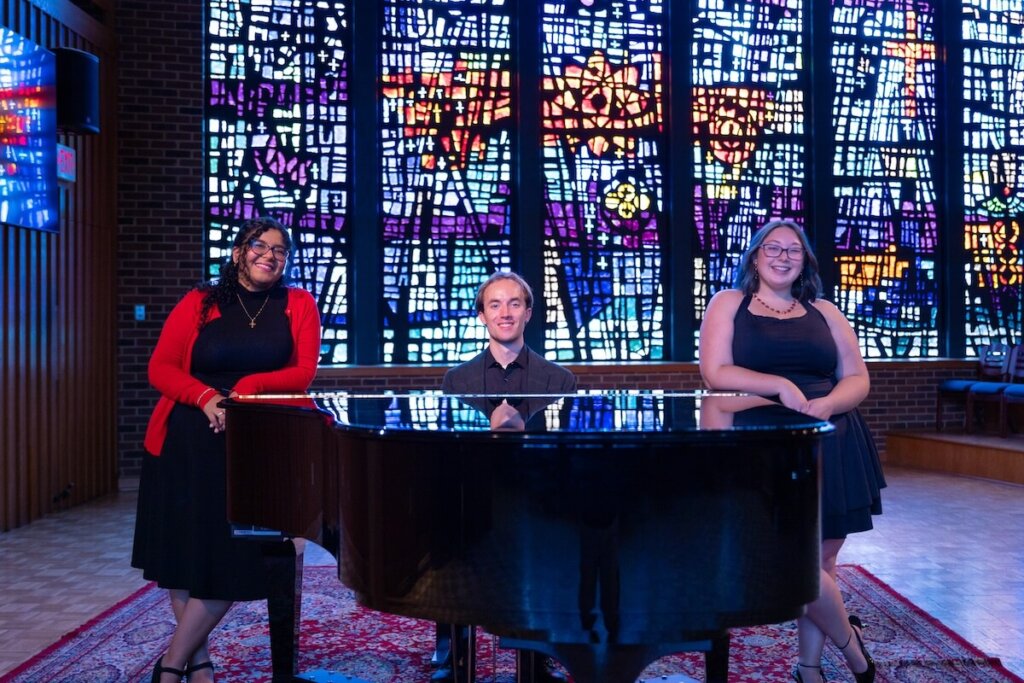
“I gained a tremendous respect for composers because it is genuinely so difficult,” said Wood, who composed a theme and variation interpretation of the folk song, “Oh Shenandoah.” His composition features theme and tonal interpretations of the eight novels of the IVM study. Wood also produced the “Introducing Virginia Mysteries” podcast. “It’s just a completely different idea of what meaning is and how to convey that,” especially in comparison to writing text. “It’s a completely different vehicle, and I had composed a few times before this project, but nothing serious, though.” He gained more insight into the painstaking nature of composing: “Just the amount of effort and the amount of someone’s life that they gave for this piece of art to exist was just a totally new dimension for me.”
The entire podcast is available on YouTube at https://music.youtube.com/playlist?list=PLYqaOPVcqvXo.
Pivotal achievements
“The IVM students brought stunning levels of energy and enthusiasm to what essentially began as a summer research institute and to what magically became a multimedia-house-style project,” Hammond said. “They are extremely bright and creative. Their work ethic and willingness to challenge themselves is beyond compare! These are pivotal achievements for our undergraduate-level students, and I am certainly honored to have had the opportunity to work with them on this multi-layered project that studies the renaissance in mystery reading and writing in Virginia as well as what the recent novels show us about Edgar Allan Poe’s ongoing influences in popular literature and recent evolutions in contemporary life, values, and culture here, as well.”
An injury prevention protocol for gymnasts and cheerleaders
In a totally different field, exercise science major Sean Salas ’29 performed a feasibility study on protocol for gymnasts and cheerleaders to prevent wrist and ankle injuries. Salas has been both a gymnast and cheerleader, and remains a gymnastics coach at Gym America in Herndon, Virginia. Salas told Associate Professor of Exercise Science Robert Hilliard, Ph.D., CMPC, that he wanted to look into the causes of the similar injuries he’d seen in these populations, and Dr. Hilliard suggested the summer program.
“This was very Sean-driven and I provided support,” Dr. Hilliard said. “He tackled a very difficult design for his first project — a real-life applied intervention. He put in a tremendous amount of work designing the intervention and thinking about all the small ethical and procedural details that go into a trial like this. I’m excited to see how he moves the project forward.”
Maintaining stability
“What we found is that it’s best to strengthen proximal musculature,” Salas said. For example, in the wrist, he said if the proximal musculature is weak, the wrist has to do more work to achieve the necessary stabilization.
“With that feasibility study, we did a weeklong intervention instead of the full four-to-six week protocol, and only the primary measurements. We were just tracking how long it takes to do things, [and determining] how many people are interested in doing it? How long it takes out of practice, how much time it takes to do the measurements, to teach the intervention, all the things. Basically, being able to give the gyms a better time frame – it’s gonna take exactly this long. And then that way, we know that when we’re writing the protocol, writing the presentation, we’re ready to give them more information on what we’re actually doing.”
Future research plans
Salas, who is also an early assurance Doctor of Physical Therapy student, a theatre minor, section leader for the Shenandoah University Marching Band’s rock band, and owner of his own sound business who also does some tech work for regional high school marching bands, hopes to continue his research and implement the protocols and eventually publish his findings. He noted that the research could also be of benefit to performing artists such as musicians, dancers and actors, and he is interested in perhaps focusing his future physical therapy work in that world.
He said he would love to see the protocols, as they’re developed, become a universal part of training, building smaller muscles to provide better stability, and, hopefully, resulting in fewer injuries.
Creating phishing awareness program
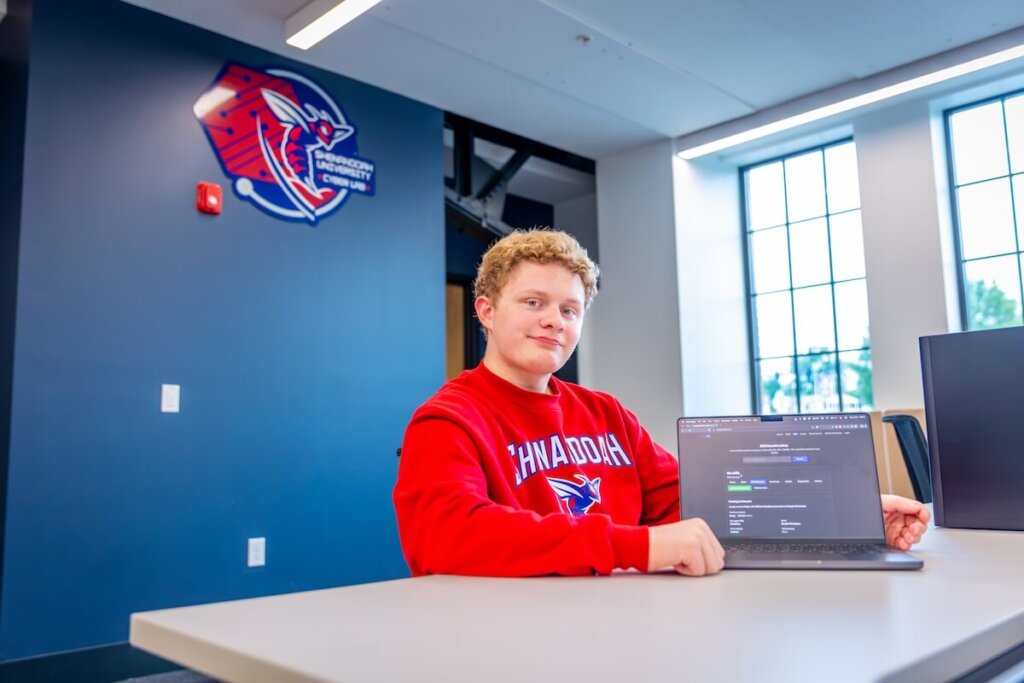
Another CAS Summer Scholars project focused on cybersecurity. Students Aidan Young ’28, Michael Ballenger ’28, Dylan Nakai Wilson ’28, and Jayden Dillard ’27 partnered with a small business, friends and family to examine phishing awareness. Their work included interviews, surveys and passive reconnaissance, and resulted in a training program that included a Kahoot-style game, a quick-reference checklist for spotting suspicious activity, and scenario-based quizzes.
The research proved a bit surprising for Wilson. “It showed me how much of cybersecurity is really about people, not just technology,” Wilson said. “Going in, I expected the biggest gaps to be more on the technical side, such as outdated software, weak configurations, that kind of stuff. But even when we found issues like reused passwords or missing MFA (Multi-Factor Authentication), the root cause usually traced back to a lack of awareness or an unclear process for reporting concerns. That shifted how I think about defense overall: technical controls matter, but they’re only as strong as the people using them.”
Hands-on cybersecurity practice
Wilson’s interviewing skills improved, as well, “since we had to get honest, useful answers from participants without making them feel judged. I also got hands-on practice with passive reconnaissance techniques and security header checks, and learned how to take a pile of raw findings and prioritize them into the risks that actually mattered most. On top of that, I sharpened my ability to translate technical findings into training that’s actually usable for a non-technical audience, which was a very different skill to learn because I wasn’t just writing up the findings themselves.”
“I would definitely recommend the summer research project to others,” Wilson added. “It’s one thing to learn about social engineering in a classroom and another to interview real people, analyze real gaps, and watch a training program actually change behavior. It also reinforced how much teamwork matters. One of the biggest lessons from this project was how much smoother everything goes when the team collaborates well, which isn’t something you always get out of a normal class assignment.
Benefits of summer research
“I think the summer research project is a magnificent opportunity for students to be a part of, and I’d especially recommend it to incoming juniors/seniors, and even recommend it to freshmen/sophomores who are studying the field,” Wilson continued. “For the newer students, it gives them an idea of what is offered, what to look for, and what opportunities Shenandoah University offers outside of lectures and assignments, and how the concepts they’re learning connect to real risks that real organizations face. For upperclassmen, it’s a chance to take everything they’ve built up over their coursework and actually apply it, under real constraints, with a real outcome on the other end. It’s the kind of experience that sticks with you well beyond the summer it happens in.”
Environmental studies students Andrew Fetch ’26 and Shelby Ramos ’27 also participated in the program.
Students presented their work at a Summer Scholars research symposium, which also featured a presentation by Shenandoah University McCormick Civil War Institute Dr. Brandon H. Beck Summer Fellows Doa’a Salah ’28 and Eli Roberds ’28, who researched some of the disallowed claims from the post-Civil War Southern Claims Commission for Winchester and Frederick County, Virginia. The pair’s findings will eventually be published in future volumes of the Journal of the Shenandoah Valley During the Civil War Era.
Salas said he found the symposium presentations to be fascinating, and he thoroughly recommends the program. “I will say to people who are interested in doing something like this, 100% take it.”