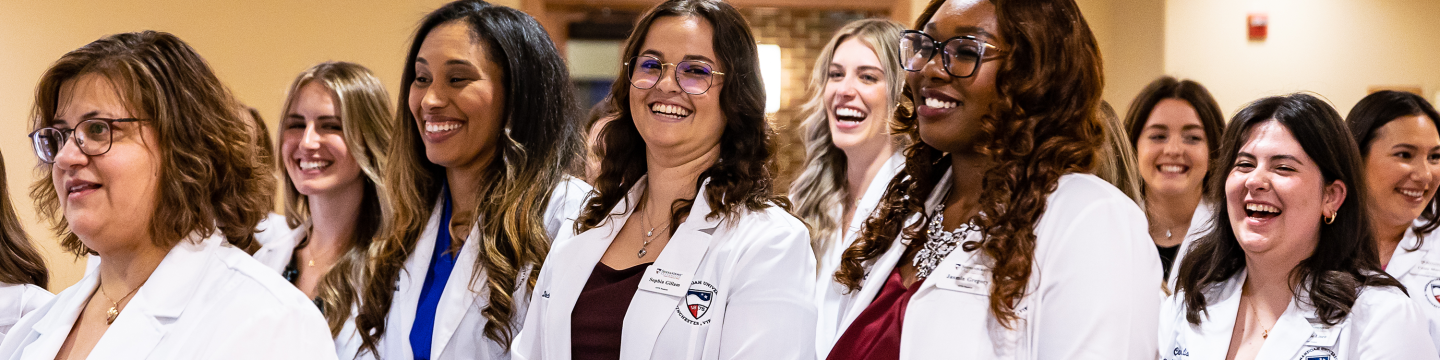
Doctor of Occupational Therapy
Shenandoah University’s 107-Credit Doctor of Occupational Therapy Is Delivered In A Flexible, Hybrid Format, With A Combination Of Online And Applied Learning Opportunities In The Classroom And Community.
Occupational therapy is a form of therapy for those recuperating from physical or mental illness that encourages rehabilitation through the performance of activities required in daily life. Shenandoah University’s Division of Occupational Therapy (SUDOT) program prepares you to become a skilled and compassionate occupational therapist, serving a diverse range of patient populations in a variety of health care and community-based settings.
As a non-traditional student, I appreciate the support and independence of SU’s OTD hybrid learning program; where my classmates have become more like family and I can be authentically me.
Uneque Chesser ’25 | Doctor of Occupational Therapy
Student & Program Outcomes
Shenandoah University is committed to transparency and continuous program improvement. In accordance with ACOTE® Standard A.4.2, accurate and current student and program outcome data are publicly available.
Please view the program’s outcomes by clicking here: Program Outcomes
Outcome data are reported for the previous three (3) years and include:
- Number of Program Graduates
- Graduation Rate
An active direct link to NBCOT® program data results is also provided by clicking here: NBCOT® Program Data Results
One Bank Street, Suite 300
Gaithersburg, MD 20878
Phone (301) 990-7979
Fax (301) 869-8492
Accreditation Status (ACOTE®)
The Entry-Level Doctor of Occupational Therapy (OTD) Program at Shenandoah University is accredited by the Accreditation Council for Occupational Therapy Education (ACOTE®) of the American Occupational Therapy Association (AOTA).
ACOTE®
7501 Wisconsin Avenue, Suite 510E
Bethesda, MD 20814
Phone: (301)652-6611
Website: www.acoteonline.org
Cost of Attendance (Tuition & Fees)
Shenandoah University is committed to providing accurate and transparent cost information for prospective students. The total cost of attendance for the Entry-Level Doctor of Occupational Therapy (OTD) Program—including current tuition and fees and the estimated total cost to complete the program—is available by clicking at this link: Cost of Attendance
“The faculty in SU’s OTD program have been supportive throughout every challenge; they genuinely care about each student and want to see them succeed. Even with only seeing each other in person once a week you are made to feel like a priority.” – Madison Biggs ’26/Doctor of Occupational Therapy student
Why Choose OT at SU?
Welcome to Shenandoah University’s Division of Occupational Therapy. We offer three distinct entry-level programs in unique hybrid and online curriculum models to meet the needs of diverse learners. Our students graduate prepared to be a leader in the field of occupational therapy and make a difference locally, nationally, and abroad.
Shenandoah University’s Occupational Therapy Program offers students the opportunity to learn all the skills they will need as entry-level occupational therapists. These skills include evaluation of clients, treatment planning, being an evidence-based practitioner, and specific treatment interventions such as adaptations to the client’s environment, splinting and mobility skills.
The majority of coursework in Shenandoah University’s Occupational Therapy Programs is based on a hybrid model with over 50% of the content delivered online. Online work includes recorded lectures, readings, and various interactive online assignments.
The format is flexible, with students gaining foundational understanding via assigned reading, online lectures, virtual discussions, and projects. Students also benefit from hands-on practice that emphasizes the synthesis of occupational therapy theory, evidence, and its application to clinical practice during in-person classes. Our facilities offer lab spaces where students are able to practice in simulated pediatric and adult settings, as well as work with community partners to advance their skills. Students then enter their fieldwork experiences prepared to implement the knowledge gained during formal coursework and graduate with the confidence required to enter the dynamic and exciting field of occupational therapy. View all of Shenandoah University’s Occupational Therapy Programs.
The OTD program has Level I fieldwork experiences built into many courses, as well as a Specialization Level I Fieldwork for an emerging or specialized practice area (NICU, hands, burns, telehealth, etc.). Students will also complete two 12-week Level 2 Fieldwork placements, one in an adult setting and one in a pediatric setting.
Shenandoah University’s Entry-Level Doctorate in Occupational Therapy program was started in 2020. The first class graduated in May 2023.
Many future employers offer financial assistance while a student is in school or loan repayment options after graduation.
Occupational Therapy Rankings
- The current U.S. News and World Report ranked Occupational Therapists as #8 in Best Health Care Jobs and #23 in 100 Best Jobs in 2025.
- The current US News and World Report indicated that occupational therapists made a median salary of $96,370 in 2023 and that the Bureau of Labor Statistics projects the profession to grow by 11.1% from 2023-2033.
Occupational Therapy Salary Projections
Recent reports from OTD alumni indicate that a majority of full-time starting salaries were between $60,000-$80,000 (sample size 13 respondents from class of 2023 working full-time).
62% | $60,000-$80,000
38% | $80,000-$100,000
Recent alumni obtained entry-level positions in:
- early intervention
- school system
- outpatient (peds, adults, specialty services)
- rehab hospital (non-mental health)
Data from 2024 indicates that all reporting recent grads who were looking for employment after graduation were employed in either traditional OT (80%) , emerging practice OT (13%) or non-OT (7%) related positions within 12 months of graduating.
Shenandoah University’s 107-credit three-year Doctorate of Occupational Therapy is delivered in a flexible, hybrid format, with over 50% of the content delivered online.
As part of the hybrid curriculum, our students engage in weekly face to face learning on Tuesdays with their peers and faculty members. These experiences are well planned and executed to maximize learning outcomes to supplement online materials. Examples include students working in small groups to analyze the systems of a homeless shelter in order to make health promotion recommendations, students working in pairs with children to increase balance, posture, coordination and sequencing at an equine assisted therapy ranch, and students working alone with community members to understand their client’s self-perceptions of performances in everyday activities.
*This course cannot be completed before semester 2 of the program nor after semester 6. This course will be offered at various times throughout the curriculum depending on the type of learning experience that is offered.
**Marks all online courses.
Semester 1 (Summer): Foundational OTD
OT 700 Foundations of Occupational Therapy
This course introduces students to occupational therapy history, the philosophical basis of the profession, theories and models of practice and frames of reference that shape professional practice. (3 credits)
OT 701 Experiential Learning and Professionalism
This is a preparatory course for the Level I and Level II Experiences. Students will examine the experiential learning component of the occupational therapy curriculum and OT professionalism. (1 credit)
OT 702 OT Framework and Task Analysis
This course explores the dynamic nature and purpose of occupations. Students will explore occupations throughout the lifespan and apply the OT profession’s framework in order to observe, analyze and synthesize the client’s engagement with occupations. (3 credits)
OT 705 Research: Introduction**
This course will set the foundation for the research course progression by introducing foundational concepts including evidence-based practice, levels of evidence, research traditions and the role of theory in research. (2 Credits)
OT 714 Occupation & Health: Participation
This course will address the relationship of philosophy and research to health and occupation. Students discuss theories and models linking occupation to individual health, public health and health changes. (3 credits)
Semester 2 (Fall)
OT 710 Group Dynamics
This course prepares students to understand the theoretical foundation of group dynamics in occupational therapy practice and to apply principles of group process within a variety of settings across the lifespan. (3 credits)
OT 711 Level I Experience: Group Dynamics
This course is the first of the seven Level I experiences sequence. In groups, students will design and implement group interventions. In their groups, students will utilize occupational models to plan clinically appropriate activities and discussions in small group formats. (1 credit)
OT 712 Communication and Documentation**
This course introduces students to multiple platforms for interacting and communicating effectively and professionally. Students will utilize technology to analyze and evaluate occupation and occupational needs through effective communication with patients, families, communities and interprofessional and intraprofessional team members. (2 credits)
OT 714 Occupation & Health: Participation
This course will address the relationship of philosophy and research to health and occupation. Students discuss theories and models linking occupation to individual health, public health and health changes. (3 credits)
OT 715 Research: Quantitative**
This is the second course in the research sequence and will focus on the development of skills to validate practice, evaluate evidence and inform clinical decisions. This course introduces quantitative (experimental) design and statistical analyses typical in occupational therapy research through design, implementation and analysis of a quantitative project. (3 credits)
OT 718 Occupational Performance: Neurological
This course emphasizes the dynamic interactions between the central nervous system, peripheral nervous system and occupational engagement. (4 credits)
Semester 3 (Spring)
OT 720 Devices, Technology, Accessibility
This course focuses on the assessment and application of environmental interventions. Methods of educating clients to improve their occupational performance, collaborating with clients to select and modify environmental interventions, and advocating for funding and policies to support environmental interventions will be addressed. (3 credits)
OT 721 Level I Experience: Community
This course is the second of the seven Level I experiences sequence. In groups, students will apply scientific and theoretical knowledge to the OT Process in various communities, populations and settings. (1 credit)
OT 723 Theoretical Perspectives
This course is designed to examine the theories, models of practice and frames of reference that guide and inform interventions for persons, groups and populations in a variety of occupational therapy practice contexts and environments. (2 credits)
OT 725 Research: Qualitative
This is the third in the research course sequence and introduces interview and observation through the lens of qualitative research methods. This course introduces qualitative design typical in occupational therapy research through design, implementation and analysis of a qualitative project. (2 credits)
OT 732 Occupation & Health: Service Delivery and Systems
This course will provide an overview of healthcare management principles necessary for understanding, applying and practicing in a diverse healthcare environment. The interplay of dynamic OT healthcare systems, intervention planning and outcome measures will be examined in relationship to political, regulatory, economic and social forces that affect OT service delivery. (3 credits)
OT 734 Occupation & Health: Population**
This course will explore population health in relationship to social determinants, health literacy and contextual factors. The relationships of these factors to the health and well-being of populations are also explored. (2 credits)
Semester 4 (Summer II)
OT 740 Assessments
This course instructs students in the process of selecting and applying assessments to determine the need for occupational therapy intervention. The merging of cultural and contextual client factors with scientific evidence, current occupational therapy best practice and bias will be addressed in relation to assessment choice. (3 credits)
OT 741 Level I Experience: Assessments
This course is the third of the seven Level I experiences sequence.Students will observe and apply assessments during occupational therapy intervention. Students will interpret the ways that assessment choice is influenced by cultural and contextual client factors, scientific evidence, current occupational therapy best practice, and bias. (1 credit)
OT 744 Traditional and Emerging Practice Areas
This course focuses on students’ development of practice skills across traditional and emerging practice areas. Methods of educating clients to improve their occupational performances and collaborating with individual clients, groups and other interprofessional team members. (3 credits)
OT 755 Research Project: Intro && Design
In this course, students will work in small groups with a research mentor to critique scholarly literature that will support a research project. Based on the review of literature, students will design and develop a project to submit for institutional review board (IRB) approval that fills the gap in knowledge identified in the literature review. (3 credits)
OT 818 Teaching & Learning**
This course focuses on learning theories within the context of healthcare practice and higher-level education in order to effectively acquire skills for clinical and academic teaching roles. (2 credits)
Semester 5 (Fall II)
OT 746 Doctoral Capstone: Introduction**
This course is the first of a four-course capstone sequence. Students explore clinical practice skills, research approaches, administration, leadership, program and policy development, advocacy, education and theory development of occupational therapy professional practice in order to develop an individual capstone project idea. (2 credits)
OT 805 Research Project: Implementation
Students will continue to work in small groups with a research mentor to implement the research project designed in the previous semester. (2 credits)
OT 810 Occupational Performance: Mental Health
This practice-focused course requires analysis and application of the occupational therapy process for individuals with mental health conditions in a variety of treatment settings. Occupational performance capacities and limitations for pediatric, adolescent and adult populations will be analyzed using both standardized and non-standardized assessments. (3 credits)
OT 811 Level I Experience: Mental Health
This course is the fourth of the seven Level I experiences sequence. Students will observe the therapeutic process and apply scientific, theoretical, and practical knowledge to practice in behavioral health, or to psychological and social factors that influence occupation. (1 credit)
OT 817 Leadership and Management
This course examines the management and leadership skills necessary in occupational therapy practice. Emphasis is placed on the application of management strategies and development of knowledge in multi-level systems. (3 credits)
OT 820 Occupational Performance: Pediatrics
This is an advanced course in pediatric interventions in which therapeutic skills needed to work with a variety of pediatric clients and their families are addressed. Students will apply occupational therapy models, frames of reference and scientific evidence to evaluations, interventions, and community programming in specific pediatric practice areas. (3 credits)
OT 821 Level I Experience: Pediatrics
This course is the fifth of the seven Level I experiences sequence. Students will observe the therapeutic process and apply scientific, theoretical, and practical knowledge to practice with pediatric clients and their families. (1 credit)
Semester 6 (Spring II)
OT 825 Research Project: Completion
This course is the final course in the research sequence. Students will continue to work in small groups to complete the research project and disseminate findings. (2 credits)
OT 830 Occupational Performance: Adults
This is an advanced course in adult interventions in which therapeutic skills are needed. Students will apply occupational therapy theories and models, complete specialized evaluations and treatments of adult clients and create appropriate goals for adults with diverse diagnoses. (4 credits)
OT 831 Level I Experience: Adults
This course is the sixth of the seven Level I experiences sequence. Students will apply occupational performance assessments and occupational therapy practice with adult individuals or communities. (1 credit)
OT 836 Professional and Scholarly Practice**
This course focuses on the process of locating and securing grants and promotion of the occupational therapy profession through education of other professionals, service providers, consumers, third-party payers, regulatory bodies, and the public. (2 credits)
OT 837 Occupation & Health: Policy & Advocacy**
This course will examine current policy issues relative to OT practice. Future service delivery models to address societal needs will be examined. Professional policy issues related to ethics and liability will be addressed in the context of professional interactions and service provision. (2 credits)
OT 847 Doctoral Capstone: Design
This course is the second of a four-course capstone sequence. Students design individualized doctoral capstone projects in one or more areas: clinical practice skills, research skills, administration, leadership, program and policy development, advocacy, education or theory development. (3 credits)
OT 801 Level 1 Experience: Specialization*
This course is the final of the seven Level I experiences sequence. Students will explore and practice scientific, theoretical, and practical knowledge in areas of practice with individual learning projects. (1 credit)
Semester 7 (Summer III)
OT 851 Level II Fieldwork A
This course is the first of two Level II experiences sequence; the sequence is intended to prepare competent, entry-level, generalist occupational therapists. Clinical placements expose students to a variety of client ages, diagnoses, and clinical settings, and provide experiences that promote clinical reasoning, professionalism, and reflective and ethical practice. Students complete a minimum of 24 weeks full-time supervised by an occupational therapist. (Part 1 of 2) (6 credits)
Semester 8 (Fall III)
OT 852 Level II Fieldwork B
This course builds on the clinical work completed in OT 851 and expands student experience in delivery of OT services. The goal of this experience is to allow students to increase clinical skills, professionalism, clinical reasoning and demonstrate competency to that of an entry-level OT practitioner (Part 2 of 2) (6 credits)
Semester 9 (Spring III)
OT 858 Doctoral Capstone: Experience
This course is the third of a four-course capstone sequence. Students develop advanced knowledge in a specific area of focus under the supervision of a site mentor in one or more areas: clinical practice skills, research skills, administration, leadership, program and policy development, advocacy, education or theory development. (8 credits)
OT 859 Doctoral Capstone: Dissemination
This is the final course in the doctoral capstone sequence. Students disseminate capstone experiences and project outcomes with the larger community. Students demonstrate scholarly work and specialty experience beyond that of an entry-level practitioner. (3 credits)
Graduates of the program will be eligible to sit for the National Certification Examination for the Occupational Therapist administered by the NBCOT. After successful completion of this exam, the individual will be a registered occupational therapist. Most states require licensure to practice; however, state licenses are usually based on the results of the NBCOT certification examination. A felony conviction may affect a graduate’s ability to sit for the NBCOT certification examination or attain state licensure. In addition, fieldwork placements may be limited or unattainable in out of state locations due to varying state restrictions.
View our program results from the National Board for Certification in Occupational Therapy (NBCOT).

At its meeting on December 2-4, 2022, ACOTE reviewed the Report of On-Site Evaluation (ROSE) regarding the Occupational Therapy Doctoral Program at Shenandoah University, Winchester, Virginia. All standards were found to be compliant and ACOTE voted to Grant a Status of Accreditation for a period of 7 years.
The program’s Interim Report will be due in April 2026 and the next on-site evaluation will be scheduled within the academic year 2029/2030.
Strengths of the Program:
- The program director is recognized for her commitment to division expansion, faculty mentorship, and team culture. Her leadership and role modeling have resulted in increased access to occupational therapy education that accommodates a diverse range of students and supports the development of vested and collaborative faculty.
- The academic fieldwork coordinator is commended for establishing seven distinct community-based Level I fieldwork experiences that are integrated into the curriculum and provide opportunities for the students to explore occupation within a variety of contexts and populations. These experiences have led to students who report being confident with their therapeutic use of self and critical thinking skills.
- The doctoral capstone coordinator is complimented for developing and facilitating a capstone process that highlights the identity of the occupational therapy doctoral program. His approach and expertise strengthen the connection between the curriculum and doctoral capstone beginning term one and serves as a source of motivation and pride for students, faculty, administration, and community partners alike.
- The faculty are acclaimed for their commitment to the curriculum, passion for student learning, and collaborative teaching methods. Their intentional delivery of reflective and experiential learning opportunities promotes highly valued, student-centric instruction resulting in students well-prepared for a wide range of Level II fieldwork and capstone experiences.
- The community partners, including fieldwork sites, capstone sites, volunteers, and guest lecturers, are acknowledged for their support in the provision of innovative educational opportunities. Participation in these community-supported learning opportunities is recognized by the students as important to their application of didactic knowledge and preparation to rapidly integrate into new clinical environments.
- The students are applauded for the energy and initiative shown in seeking and improving upon learning opportunities. This commitment has led fieldwork educators and capstone mentors to recognize the students as fast, independent learners adept at evidence-based practice.
Suggestions to enhance the program
- 2018 Standard D.1.8. Capstone Project: The program has a process to ensure completion and dissemination of the individualized capstone projects. The capstone mentors and students expressed interest in developing dissemination opportunities to ensure project results are shared with site stakeholders. It is suggested that the program explore ways to enhance student planning for dissemination of capstone project results to maximize the impact of research and the sustainability of community engagement.
Areas of Concern – Response from the program is required.
- N/A
Noncompliance with the Standards.
- All Standards were found to be compliant based on the review of the materials submitted by the program and the findings of the on-site team.
The entry-level occupational therapy doctoral degree program is accredited by the Accreditation Council for Occupational Therapy Education (ACOTE) of the American Occupational Therapy Association (AOTA).
ACOTE c/o Accreditation Department
7501 Wisconsin Avenue, Suite 510E
Bethesda, MD 20814
(301) 652-AOTA
www.acoteonline.org
Graduates of the program will be eligible to sit for the national certification examination for the occupational therapist administered by the National Board for Certification in Occupational Therapy (NBCOT). After successful completion of this exam, the individual will be an Occupational Therapist, Registered (OTR). In addition, all states require licensure in order to practice; however, state licenses are usually based on the results of the NBCOT Certification Examination. Note that a felony conviction may affect a graduate’s ability to sit for the NBCOT certification examination or attain state licensure.
Students must complete 24 weeks of Level II Fieldwork as well as an individual 14-week capstone experience. The doctoral capstone experience must be completed within 12 months after all coursework and Level II fieldwork is successfully completed as defined in the 2018 ACOTE OTD Standard D.1.3.
Faculty in the Shenandoah University Occupational Therapy Doctorate (OTD) program are doctoral-prepared scholar–clinicians whose work integrates advanced practice, leadership, and scholarship. Collectively, faculty expertise includes:
- Neurological and adult rehabilitation
- Pediatrics and developmental practice
- Maternal mental health, perinatal and pelvic health
- Assistive technology and innovative rehabilitation tools
- Community, population, and emerging practice settings
- Qualitative and mixed-methods research
- Cultural competency, global health, and refugee/underserved populations
- Applications of technology and artificial intelligence in rehabilitation and education
- Interdisciplinary and systems-based models of care
Faculty also contribute through:
- Leadership in accreditation, curriculum design, and program development
- Doctoral capstone mentorship and experiential learning partnerships
- Active clinical engagement across hospital, rehabilitation, and community settings
- National and international scholarship, including Fulbright-funded academic work and global collaborations
- Professional service, research dissemination, and community-engaged initiatives
This integration of clinical expertise, scholarship, leadership, and systems-level thinking prepares graduates to lead innovation and advance occupational therapy practice in complex and evolving healthcare environments.
Shenandoah University’s Division of Occupational Therapy requires all applicants to go through OTCAS for the application process. This is an online centralized application service located at www.otcas.liaisoncas.com which has a thorough and accurate list of all required documents and prerequisites for the program. You can also find prerequisite information on the Program Admission Prerequisites tab below.
Application Timeline
| OTCAS Opens | Mid-July |
| Priority Deadline | November 15 |
| Rolling Deadline | May 1 (applications accepted continually based on availability) |
| Interviews | Held monthly September through April |
| Classes Start | Mid-May |
| OTCAS Closes | June 1 |
- Once applications are verified in OTCAS, they will be reviewed by the Admissions Team. If the application is complete and meets minimum admissions requirements, it will be reviewed by two faculty members. If the application is incomplete and does not meet the minimum admissions requirements, the Admissions Team notifies the applicant through OTCAS.
- Faculty will then review the application.
- If the Faculty Review is favorable, the Admissions Team invites the applicant to interview via Zoom. If the Faculty Review is not favorable, the applicant will be notified that their application has not been accepted for this admissions cycle.
- Acceptance offers are emailed through OTCAS to applicants after the interview process.
- Graduate Admissions will follow up via email with accepted applicants with instructions on how to officially accept the offer.
For application questions, contact otdadmissions@su.edu.
Shenandoah occupational therapy alumna Brenna Mauro shares her thoughts on what incoming OT students should know about OT school. Shenandoah University lets you benefit from her experience as she offers great advice about being successful by staying organized, being kind to yourself, and embracing the entire process of OT education.
- Bachelor’s degree or higher (in any field) from a regionally accredited institution prior to matriculation.
- A grade of “C” or above is required for all prerequisite courses. AP credits are not acceptable for prerequisite coursework.
- Three letters of recommendation from current/recent academic and/or professional contacts are required. Recommenders will complete an evaluation form via OTCAS and upload a recommendation letter. No personal references will be accepted.
- Observation hours: In order to obtain an understanding of Occupational Therapy, we recommend shadowing a licensed OT, preferably in multiple settings. While this is not mandatory, it is highly recommended in order for applicants to demonstrate knowledge of the profession.
- Personal Essay: Please write an essay explaining your motivation for choosing a career in Occupational Therapy. Discuss how pursuing this degree aligns with both your short-term and long-term professional goals. Additionally, demonstrate your understanding of Occupational Therapy as a profession. Ensure that your writing is professional and adheres to proper grammar and punctuation.
- No GRE require
PREREQUISITES
Prerequisite courses taken during the COVID-19 outbreak (Spring 2020-Summer 2022) and/or P/NC or P/F grade of “P” will be accepted for credit. In situations where candidates were awarded P/F grades, the grade point average (GPA) for those grades is not impacted in the calculation of GPA. Shenandoah University Division of Occupational Therapy will only consider the GPAs calculated by OTCAS.
The GPA requirements for program admission will not change.
Applicants must still have the following academic requirements to be admitted:
- A Minimum 3.0 overall grade point average (GPA)
- A Minimum 3.0 prerequisite grade point average (GPA) with 3.2 preferred
All students must have completed the following courses with grades of “C” or better. Classes may be completed in-person or online:
- 3 credits: General or Introductory Psychology (waived for psychology major/minor applicants)
- 3 credits: Abnormal Psychology
- 3 credits: Statistics Course (content must include descriptive and inferential statistics)
- 6 credits (minimum): Two sequential courses in Human Anatomy & Physiology. Content must include lecture and laboratory sections to include human structure and function, including the musculoskeletal system and an overview of the nervous system.
- 6 credits Social Science (two 3-credit hour courses) can include courses in: sociology, anthropology, ethics, economics, political science, community or public health, epidemiology, gerontology, religion, philosophy, gender studies, or cultural or urban studies.
- 3 credits (minimum): Life Span Human Development from infancy to the elderly (Students may have to take more than one course to meet this requirement)
- 1 credit: Medical Terminology course (CEU courses/certificates are not accepted)
- No more than 9 outstanding credits of prerequisite course work permitted at time of application.
- Outstanding credits must be shown in OTCAS as courses “in progress” or “planned” and must be completed prior to matriculation.
- No AP Credit or CLEP credits are accepted for prerequisites.
- Students must also complete all required application materials as listed in OTCAS to be considered for application.
Essential Functions And Professional Behaviors
Computer Technology Requirements
Important Information for COTA Applicants:
In the case of nationally accredited (vs. regionally accredited) institutions with program accreditation from ACOTE, Shenandoah University Division of Occupational Therapy (SUDOT) may transfer in ONLY those courses under the program accreditor’s umbrella, such as OT courses. SUDOT will not transfer in other courses, such as English, math, etc., that are not from a regionally accredited institution. All prerequisite courses must be taken at a regionally accredited institution.
Health Requirements:
All Shenandoah University Occupational Therapy students are required to have a complete health record on file with the Wilkins Wellness Center, including immunizations. The complete list of what is required is listed on the Health & Insurance Requirements page. Please note that while Shenandoah University (“SU”) may grant a request for a medical or religious exemption to one or more of the health requirements, students whose program requires clinical or experiential training should be aware that if SU grants the student’s request, it cannot guarantee SU will be able to secure the clinical/experiential assignments necessary for the student to graduate with a degree, or to obtain a licensed position, in their field.
The Doctoral Capstone Experience (DCE) provides students with an in-depth experience that culminates in a high-quality scholarly project. Students decide on an area of focus during the introduction to the DCE course. This area may include clinical practice, administration, advocacy, leadership, theory, research, program development, community practice or education/teaching. For additional information about the Doctoral Capstone Experience, visit the Capstone Projects webpage.
“I really appreciate the global perspective SU has; GEL trips are so inspiring and such a unique opportunity. There’s a great combination of cultural experiences, including more tourist-y activities, alongside fieldwork experience and practical education.” – Madison Biggs ’26/Doctor of Occupational Therapy student
Shenandoah University and the OT programs pride ourselves on our international opportunities for experiential learning. We regularly engage in interprofessional and intraprofessional abroad trips to places such as Spain, Ecuador, and Morocco for course credit. We are always open to new opportunities for expanding our collaborations abroad. Learn more about education abroad at Shenandoah!
Graduation Requirements
Students in the Shenandoah University Entry-Level Doctor of Occupational Therapy (OTD) Program must meet all published program and university requirements for graduation. Key requirements include the following:
The Occupational Therapy Doctorate (OTD) requires a minimum of 107 credit hours of occupational therapy courses for graduation. Students must begin coursework in the summer semester of the year they gained acceptance into the program. Full-time students must progress through the program within four years including fieldwork. Progression is based on the following: satisfactory completion of all course prerequisites before beginning coursework each semester; completion of all coursework with grades of “C” or better; maintenance of a 3.0 cumulative grade-point average (GPA) (no rounding); payment of all university tuition and fees; maintenance of health, clinical safety and security requirements, including CPR, physical examinations, criminal background checks, and AOTA membership throughout the program. Students must also complete required advising meetings/evaluations each semester.
Students who receive grades of “D” or “F” in a course are not permitted to take any new courses in the program and are placed on academic probation. Students may petition the faculty for the opportunity to complete required course work in order to continue progression through the program. Courses may be repeated only once. Failure to successfully complete the designated requirements within two semesters results in termination from the program. Students who receive grades of “D” or “F” in more than two courses are dismissed from the program.
OT 851 and OT 852 are full-time fieldwork experiences completed during normal working days and hours. Either fieldwork may be repeated once. Students who fail Level Two Fieldwork more than one time are dismissed from the program. All admitted students are required to review the SUDOT Fieldwork Handbook regarding specific policies. Students must also complete the doctoral capstone experience.
In addition to policies and procedures of the university and the Student Handbook, occupational therapy students are responsible for reading, understanding, and implementing the policies and procedures found in the Division of Occupational Therapy Student Handbook as well as compliance with the Shenandoah University Honor Code and professional conduct expectations.
Additional graduation requirements and academic policies are published in the Shenandoah University Graduate Catalog and the OTD Student Handbook.
Shenandoah University’s Entry Level Doctorate of Occupational Therapy program meets for face-to-face class once a week (Tuesdays) at the Health Professions Building in Winchester, Virginia. The Health Professions Building is located within the campus of Valley Health. This is a hybrid program with over 50% of the content delivered online. Students complete application of online learning content with experiences in the classroom setting working with faculty and community partners. Close faculty mentorship, combined with the program’s small class sizes and practical learning experiences, prepare you to enter the field as a professional dedicated to service, ethics, and leadership.
OTD Program – Winchester
otdadmissions@su.edu
540-678-4313
Spotlights

Shenandoah OT Programs Recognize Students & Educators of Distinction
2024-25 Awardees Hail From Four Occupational Therapy Programs

School Of Health Professions News: Summer 2024
Faculty Earn Humanitarian Award, Train CPTIs In East Africa, And Publish Research

Division of Occupational Therapy Celebrates Award Winners
Honorees hail from all four of Shenandoah's OT programs
Alumni Successes
Shenandoah OT Programs Recognize Students & Educators of Distinction
2024-25 Awardees Hail From Four Occupational Therapy Programs
Division of Occupational Therapy Celebrates Award Winners
Honorees hail from all four of Shenandoah's OT programs